Breatheasy
Calm, box or 4-7-8: which breathing exercise, and when?
Three simple breathing rhythms, what each one is good for, and what the research actually says.
 Breatheasy team26 October 2026 · 3 min read
Breathing is the one part of your body’s alarm system you can steer on purpose. That’s why breathing exercises turn up in almost every anxiety toolkit. But with so many patterns out there, it’s fair to ask: which one should you use, and when?
Why breathing changes how you feel
When you’re anxious, you often breathe fast and high in your chest. This over-breathing changes the balance of gases in your blood, which can cause tingling, dizziness and a feeling of not getting enough air. That makes panic feel worse.
Your body also has a brake pedal for its alarm system, sometimes called “rest and digest.” Slow breathing, especially with an out-breath that’s longer than the in-breath, helps press that brake.
What the research says
A 2023 review in Scientific Reports pooled 12 randomised trials with 785 adults and found that breathing exercises lowered stress compared with not doing them. Across 20 studies, they eased anxiety too. Most of the studies used slow breathing, at around 5 to 6 breaths a minute.
The authors also urge some caution: many studies were small, and they call for better-quality research. And studies haven’t compared box breathing and 4-7-8 head to head, so the best pattern is the one that feels doable for you.
The best breathing exercise is the one you’ll actually do when you need it.
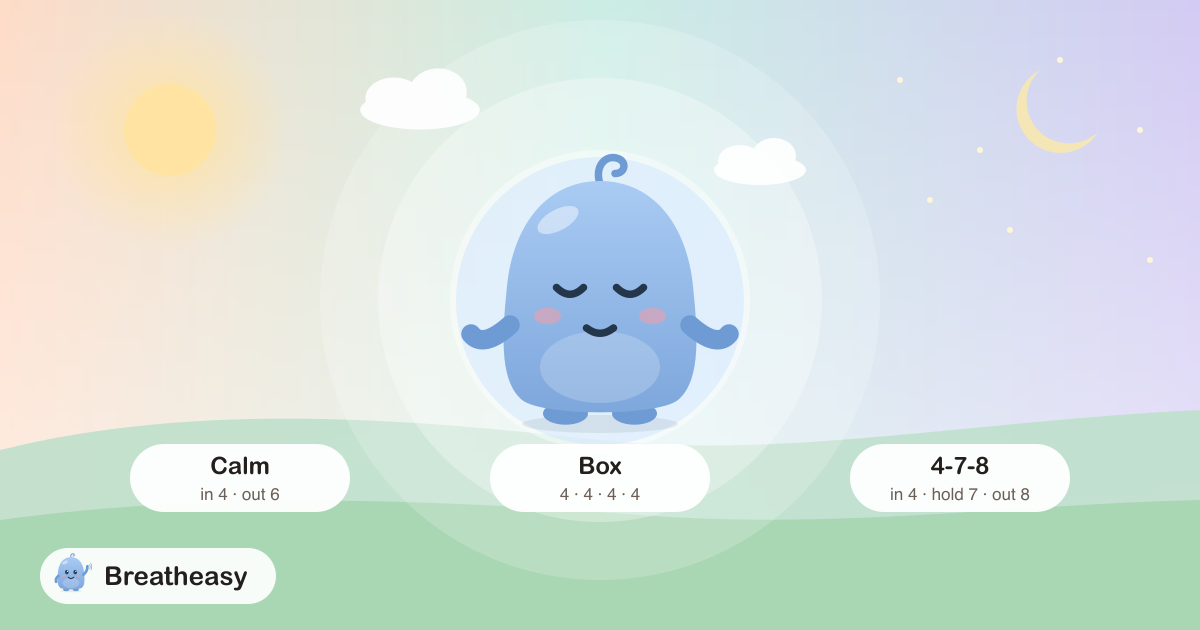
Calm breathing: in 4, out 6
Best for: panic, or any moment your body feels on high alert.
Breathe in gently for a count of 4, then out slowly for a count of 6. That’s about 6 breaths a minute, right in the range most studies used. There’s no holding, which makes it the easiest pattern when you’re already short of breath.
Box breathing: 4-4-4-4
Best for: steadying yourself before something stressful, like a meeting, an exam or a difficult phone call.
Breathe in for 4, hold for 4, breathe out for 4, and hold for 4. Picture tracing the four sides of a square. The even rhythm gives your mind something to follow, which can help you focus.
4-7-8 breathing
Best for: winding down at night.
Breathe in for 4, hold for 7, and breathe out for 8. It’s the slowest of the three, which makes it a gentle way to settle before sleep. The long holds take some practice, so start with a few rounds.
A quick guide
| Pattern | Rhythm | Best for |
|---|---|---|
| Calm | In 4, out 6 | Panic and high anxiety |
| Box | In 4, hold 4, out 4, hold 4 | Focus before something stressful |
| 4-7-8 | In 4, hold 7, out 8 | Winding down to sleep |
Tips to make it work
- Practise on calm days. Breathing works best when it’s already familiar, so it comes automatically when you need it. The NHS suggests breathing exercises for at least 5 minutes, and says you’ll get the most benefit doing them regularly.
- Go gently. Breathe as deeply as feels comfortable, without forcing it. You might not reach the full count at first, and that’s fine.
- Skip the holds if they feel bad. If holding your breath feels uncomfortable, or you have a heart or lung condition, stick with Calm.
- Feeling dizzy? Slow down and let your breathing return to normal for a moment.
Sources
- Fincham et al. (2023). Effect of breathwork on stress and mental health. Scientific Reports.
- Breathing exercises for stress, NHS