Breatheasy
What’s happening in your body during a panic attack
Why your heart races, your chest tightens and everything feels unreal, and why none of it can hurt you.
 Breatheasy team26 October 2026 · 4 min read
Your heart is pounding. Your chest feels tight, your hands are tingling, and a voice in your head is saying something is very wrong. A panic attack can feel like the most frightening thing that has ever happened to you.
Here’s what’s really going on, and why understanding it is one of the most powerful things you can do.
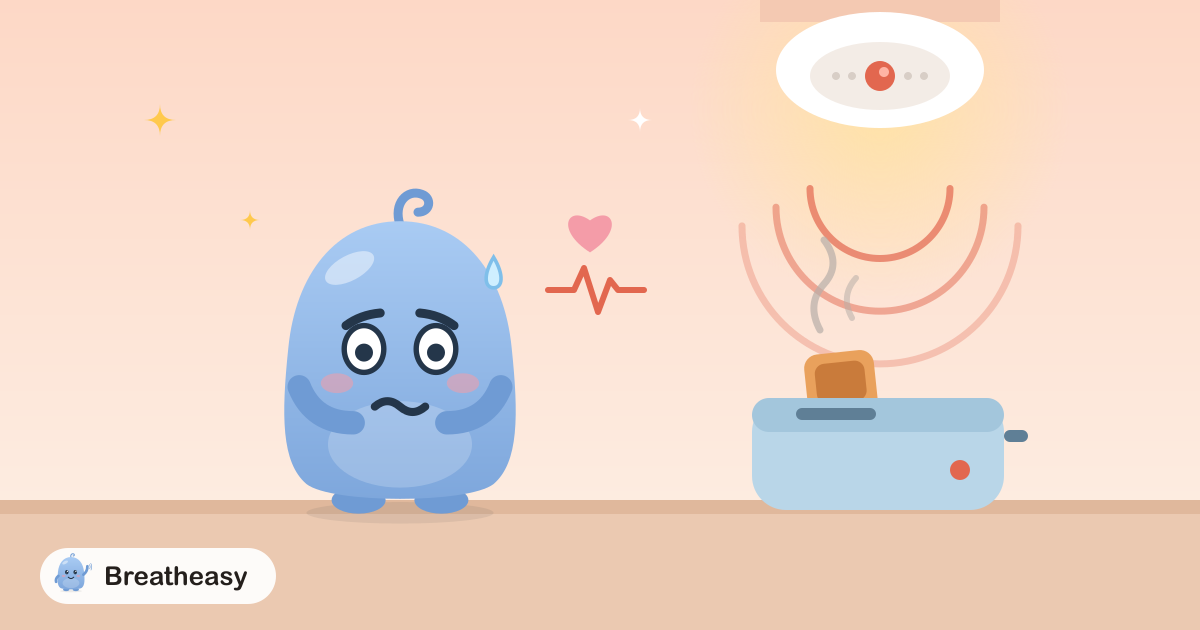
A smoke alarm going off over toast
Your body has a built-in alarm called the fight-or-flight response. When your brain thinks you’re in danger, it releases adrenaline to get you ready to fight or run. That alarm has kept humans alive for a very long time.
In a panic attack, the alarm goes off when there’s no real danger, a bit like a smoke alarm going off when you make toast. The alarm is loud and convincing, but there’s no fire.
What each feeling is for
Every panic feeling is your body trying to protect you, just at the wrong time:
- Racing heart: pumping more blood to your muscles.
- Fast breathing: bringing in more oxygen.
- Sweating: cooling you down before you run.
- Tense, shaky muscles: getting ready to move.
- Feeling unreal, or tunnel vision: your brain narrowing its focus onto the threat.
- Butterflies or nausea: digestion pausing, because it isn’t urgent right now.
The scary thoughts, and what’s really happening
During panic, your mind often jumps to the worst explanation. These are the most common fears.
“I’m having a heart attack”
A healthy heart is built to beat fast for long periods, like when you exercise. In panic, the racing comes from adrenaline, and it settles as the adrenaline fades.
“I’m going to faint”
Fainting usually happens when blood pressure drops. During panic it tends to rise, so fainting is rare. People with a strong fear of blood or needles are the exception, because their reaction works differently.
“I can’t breathe”
Panic makes you breathe faster and higher in your chest, which can make it feel like you can’t get enough air, even though you’re getting plenty. Slowing your breathing down, especially the out-breath, eases this feeling.
“I’m losing control”
Feeling unreal or detached is a common, temporary effect of adrenaline. Panic doesn’t make people lose their minds or act out of control.
Panic feels dangerous, but the feelings themselves can’t harm you.
Why panic always passes
A panic attack builds quickly, peaks, and then starts to ease. The NHS notes that most panic attacks last between 5 and 20 minutes. Once the adrenaline is used up and your body realises there’s no threat, a calming system takes over. Even when it feels endless, it is moving through you.
The panic loop, and where it breaks
Panic often follows the same loop:
- You notice a body feeling, like a skipped heartbeat or feeling light-headed.
- You read it as danger: “Something’s wrong.”
- That thought makes you more anxious.
- Anxiety releases more adrenaline, which makes the feelings stronger.
- Stronger feelings seem to prove the danger, and around it goes.
The loop runs on the danger thought in step 2. When you can tell yourself “this is adrenaline, not danger,” the cycle loses its fuel. Over time, many people start to fear the feelings themselves and watch their body closely for the first sign. That close watching makes normal sensations feel bigger. It isn’t your fault, and it can change.
What helps in the moment
- Name it. Say to yourself: “This is a panic attack. It will peak and pass.”
- Lengthen your out-breath. Breathe in for 4 and out for 6. The long out-breath presses your body’s brake pedal.
- Come back to the room. Find 5 things you can see, 4 you can feel, 3 you can hear, 2 you can smell and 1 you can taste.
- Let it come, and let it go. Fighting the feelings tends to feed them. Letting them rise and fall teaches your brain they’re safe.
When to talk to a doctor
If you’ve never had a panic attack before, or your symptoms feel different from usual, especially chest pain, get checked by a doctor to rule out other causes.
If panic attacks keep coming back, you don’t have to manage them alone. Talking therapy based on cognitive behavioural therapy (CBT) is one of the main treatments, and a large review of 72 studies found CBT helps with panic.
Sources
- Panic disorder, NHS
- Pompoli et al. (2018). Dismantling cognitive-behaviour therapy for panic disorder. Psychological Medicine.