Breatheasy
Dental anxiety: how to get through the dentist when you’re scared
Why so many people fear the dentist, what to ask for before and during your appointment, a stop signal, sedation options and their trade-offs, what to do if you faint at needles, and the therapy that helps dental phobia.
 Breatheasy team27 October 2026 · 6 min read
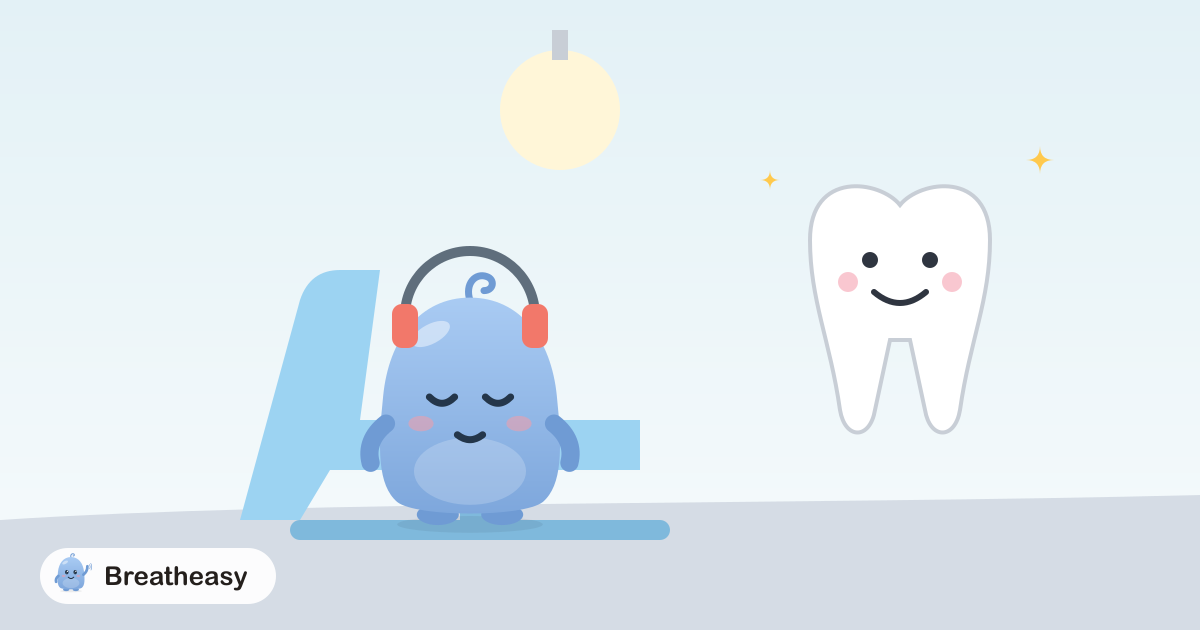
The appointment reminder arrives, and your stomach drops. You picture the chair, the bright light, the sound of the drill. Maybe you’ve put off going for months, or years.
You’re far from alone. A review of studies from around the world found that dental fear is common in adults, and more common in women. It’s something dentists see every day, and there’s a lot you can ask for to make it easier.
Why people fear the dentist
- A painful or frightening past experience, especially in childhood
- Feeling out of control, lying back with someone working in your mouth
- Fear of pain or needles
- The gag reflex, or fear of choking
- Sounds and smells, like the drill
- Embarrassment about the state of your teeth after a long gap
- Anxiety in general, including panic attacks or claustrophobia
The avoidance trap
Avoiding the dentist brings relief, but small problems can grow into bigger ones that need more treatment, which makes the next visit scarier. Breaking the cycle with a gentle first step, even just a check-up or a chat, is worth it.
Before your appointment
- Tell the practice you’re anxious when you book. Some dentists have a special interest in nervous patients. It’s fine to ask.
- Ask for a first visit that’s just a conversation, if that would help.
- Book a time that suits you, like first thing, so you don’t spend all day worrying.
- Eat a light meal beforehand, unless you’ve been told not to, and go easy on caffeine.
- Bring someone with you, if that helps.
- Practise slow breathing in the days before.
In the chair
- Agree a stop signal, like raising your hand. Knowing you can pause at any time gives you back some control, and most people use it far less than they expect.
- Ask the dentist to explain each step before they do it, and to warn you before anything that might be uncomfortable.
- Breathe slowly through your nose, making each out-breath a little longer than the in-breath.
- Wear headphones with music, a podcast or calming sounds, if your dentist is happy with that.
- Relax your body: let your hands rest open, drop your shoulders and feel the chair supporting you.
- Focus on something else: count tiles on the ceiling, picture a calm place in detail or count your breaths.
- Ask for breaks during longer treatments.
- Tell them if you can feel pain. More numbing is usually possible.
If you have a strong gag reflex
Tell your dentist. They can work in shorter bursts, adjust how you sit, use smaller instruments or try numbing sprays. Breathing slowly through your nose and focusing on something else can help too.
If you feel faint with needles or blood
Some people don’t just feel anxious about needles or blood: their blood pressure drops and they feel faint or actually faint. If that’s you, tell the dentist so you can lie back before injections.
A technique called applied tension can help. Tense the muscles in your arms, legs and body for 10 to 15 seconds, until you feel warmth rising in your face, then relax for 20 to 30 seconds. Repeat a few times. This raises your blood pressure and makes fainting less likely. It was developed specifically for blood and needle fears.
Sedation options
For some people and some treatments, sedation helps. Options vary by dentist and include:
- Nitrous oxide (“laughing gas”), breathed through a small mask. It works quickly and wears off quickly.
- Oral sedation, a tablet taken before the appointment. You’ll need someone to take you home.
- IV sedation, given through a vein, which makes you very relaxed and drowsy. You’ll need someone to take you home and stay with you.
- General anaesthetic, where you’re fully asleep, usually only for complex treatment, in a specialist setting.
Each has its own risks and preparation. Tell the dentist about all your medicines and health conditions, including breathing problems, sleep apnea and pregnancy. Sedation gets you through treatment, but it doesn’t usually reduce the fear for next time. A review of studies found some evidence that CBT may help people accept dental treatment better than general anaesthetic does.
Treatment that helps for good
If dental fear is stopping you from getting care, cognitive behavioural therapy (CBT) can help. A review of studies found that CBT and behavioural therapy reduced dental anxiety, although the quality of the research could be better. It usually involves gradually facing the dentist step by step, with support.
Ask your doctor or dentist about therapists who work with dental or needle phobia.
When to get help
See a dentist promptly if you have severe toothache, swelling in your face or jaw, a fever with dental pain, or trouble swallowing or breathing, which can be signs of a serious infection. Call 911 if swelling is spreading quickly or you’re struggling to breathe or swallow.
Frequently asked questions
Is dental anxiety a phobia?
For many people it’s ordinary nervousness. When the fear is intense, long-lasting and makes you avoid the dentist even when you need treatment, it may be a specific phobia, sometimes called dental phobia. Either way, it’s treatable.
What can I take to calm my nerves before the dentist?
Talk to your dentist or doctor rather than self-medicating. Options like nitrous oxide or prescribed sedation can be arranged for some treatments. Don’t drink alcohol before an appointment.
How do I tell my dentist I have anxiety?
Simply say it when you book or at the start: “I get very anxious at the dentist. Could you explain what you’re doing before you do it, and can we agree a signal if I need to stop?” Dentists hear this often.
Can I bring headphones to the dentist?
Usually yes. Ask your dentist first. Many patients find music or a podcast helps a lot.
How Breatheasy can help
Breatheasy can help in the waiting room and on the way there. Tap “I’m feeling anxious” and Luma walks you through it: rate how strong it feels, breathe slowly as your phone pulses gently, ground yourself with 5-4-3-2-1, then see how far the anxiety came down. Practising the breathing exercises before your appointment makes them easier to use in the chair. Breatheasy is coming soon to iPhone and Android.
Sources
- Estimated prevalence of dental fear in adults: a systematic review and meta-analysis, Silveira and others, Journal of Dentistry, 2021
- Psychological treatment of dental anxiety among adults: a systematic review, Wide Boman and others, European Journal of Oral Sciences, 2013
- Applied tension: a specific behavioral method for treatment of blood phobia, Öst and Sterner, Behaviour Research and Therapy, 1987
- Phobias, NHS
- Breathing exercises for stress, NHS