Breatheasy
The best self-help apps for mental health in 2026
Our pick of the best self-help apps for anxiety, mood, sleep, stress and trauma, including free options, what each one is best for, and what to check before you trust an app with your mental health.
 Breatheasy team27 October 2026 · 6 min read
There are thousands of mental health apps. Some are genuinely useful, some are mostly meditation libraries, and some are built more around subscriptions than your wellbeing.
Here’s our guide to the best self-help apps in 2026, what each is best for, and what to check before you download.
Full disclosure: we make Breatheasy, so we’re not neutral. We’ve put it first because it’s built for getting through anxiety as it happens, with the everyday tools for looking after your mental health. We’ve tried to describe the other apps fairly. Features and prices change, so check the app store before you decide.
Do self-help apps work?
They can help. Reviews of randomised trials have found that smartphone apps reduced symptoms of anxiety and depression more than comparison conditions, with small-to-moderate effects. The benefit was bigger compared with doing nothing than compared with other active support.
So apps are a useful tool, especially for practising skills between therapy sessions or while you wait for help. But if anxiety, low mood or trauma is affecting your life, talk to a doctor or therapist too.
What makes a good self-help app
- Evidence-based techniques, like slow breathing, grounding, CBT skills and mood tracking, rather than vague promises.
- Help when you need it, not just daily routines.
- A useful free version, especially for crisis or panic tools.
- Fair trials that don’t charge you automatically if you forget to cancel.
- Privacy: what happens to your journal, mood data and chats?
- Safety: does it point you to real help, like 988 or 911, when you need more than an app?
1. Breatheasy: best all-round self-help app for anxiety
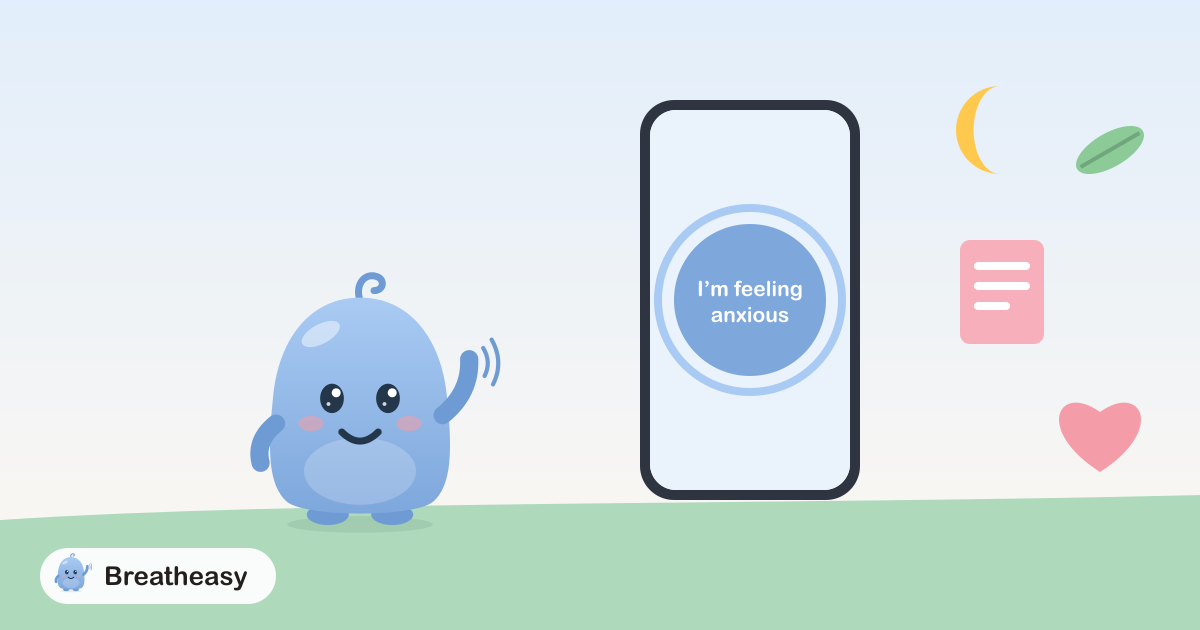
Breatheasy is built around one big button: “I’m feeling anxious.” Tap it and Luma, a friendly blue character, walks you through it: rate how you feel from 1 to 10, breathe slowly as your phone pulses gently, ground yourself with 5-4-3-2-1, then see how far the anxiety came down.
Free forever: the panic button, breathing exercises (Calm, Box and 4-7-8) with gentle vibrations, a tool for riding out urges, ten-second check-ins and a journal, a two-week anxiety check, calming games and a Calm Garden, a kind streak with a free rest day, and crisis help and an emergency contact one tap away.
Premium: chats with Luma, an AI companion with crisis safety built in, the full set of short lessons, mood patterns and insights, and all sleep sounds and bedtime stories.
Price: $4.99 a month or $39.99 a year, after a 3-day free trial that needs no card and never charges you automatically.
Privacy: we don’t sell your data, show you ads or use advertising or analytics trackers. The panic button works without an account and without internet, and chats with Luma stay on your phone.
Best for: anxiety and panic, plus gentle everyday self-care.
Worth knowing: Breatheasy is coming soon to iPhone and Android, so it isn’t in the app stores yet.
2. How We Feel: free mood check-ins
How We Feel is a free app from a nonprofit, The How We Feel Project. It helps you find the right word for how you feel, spot patterns over time, and try short video strategies, like changing your thinking, moving your body or reaching out.
Price: free.
Best for: understanding your emotions and building emotional vocabulary.
3. PTSD Coach: free help after trauma
PTSD Coach is a free app from the US Department of Veterans Affairs, for anyone who wants to learn about and manage symptoms after a trauma, not just veterans. It includes information about PTSD, symptom tracking, tools for managing stress, and links to support. The VA notes that it isn’t meant to replace professional care.
Price: free.
Best for: people living with the effects of trauma, and their families.
4. Insomnia Coach: free help with sleep
Insomnia Coach is another free VA app, created for everyone. It’s based on cognitive behavioural therapy for insomnia (CBT-I), the recommended first treatment for long-term insomnia, and includes a weekly training plan, a sleep diary and tools for better sleep.
Price: free.
Best for: people who struggle to fall or stay asleep.
5. Daylio: simple mood and activity journal
Daylio lets you keep a mood journal without typing: pick your mood and what you did that day, then look back at statistics and patterns.
Price: free, with an optional Premium upgrade.
Best for: quick mood tracking.
6. Finch: gentle self-care habits
Finch turns small self-care goals into caring for a virtual pet bird. It’s soft, friendly and good for building small daily habits.
Price: core features free, with an optional paid tier.
Best for: building gentle routines, especially if mental health apps feel intimidating.
7. Insight Timer: the biggest free meditation library
Insight Timer has a very large library of free guided meditations and talks from many different teachers.
Price: most content is free, with an optional paid tier.
Best for: people who want lots of free meditation options.
8. Headspace and Calm: guided meditation and sleep
Headspace and Calm are two of the best-known wellbeing apps, with guided meditations, courses on stress and anxiety, and sleep content.
Price: some free content, with subscriptions for full access.
Best for: building a regular meditation habit and winding down for sleep.
Which app is right for you?
| If you want… | Try |
|---|---|
| Help in the middle of anxiety or panic | Breatheasy |
| To understand your emotions | How We Feel, Breatheasy |
| Help after trauma | PTSD Coach |
| Better sleep | Insomnia Coach, Breatheasy, Calm |
| Quick mood tracking | Daylio, Breatheasy |
| Gentle daily habits | Finch, Breatheasy |
| Free meditation | Insight Timer |
Our posts on the best apps for anxiety and free apps for anxiety compare more apps for anxiety specifically.
When an app isn’t enough
See a doctor if anxiety, low mood or sleep problems are affecting your life, you’re having panic attacks or flashbacks, or self-help isn’t helping. Talking therapies like CBT, and sometimes medicine, help most people. If you’re having thoughts of ending your life, call or text 988 (US) now, or call 911 in an emergency.
Frequently asked questions
What is the best self-help app for mental health?
It depends on what you need. For anxiety and panic, we built Breatheasy to help in the moment. For free options, How We Feel is good for emotions, PTSD Coach for trauma and Insomnia Coach for sleep.
Are there free self-help apps?
Yes. How We Feel, PTSD Coach and Insomnia Coach are free, and Breatheasy’s panic button, breathing, journal and check-ins are free forever.
Can a self-help app replace therapy?
No. Apps can help you practise skills and track how you feel, and research shows they can reduce symptoms a little. But for an anxiety disorder, depression or PTSD, therapy is far more effective.
Are mental health apps private?
It varies. Read the privacy policy, check whether you need an account, and see what happens to your journal, mood data and chats.
Sources
- The efficacy of smartphone-based mental health interventions for depressive symptoms: a meta-analysis of randomized controlled trials, Firth and others, World Psychiatry, 2017
- Can smartphone mental health interventions reduce symptoms of anxiety? A meta-analysis of randomized controlled trials, Firth and others, Journal of Affective Disorders, 2017
- PTSD Coach, VA Mobile
- Insomnia Coach, VA Mobile
- How We Feel on the App Store, Apple
- Daylio on the App Store, Apple