Breatheasy
Mental health exercises: 20 simple exercises for anxiety, stress and low mood
Twenty evidence-based mental health exercises you can do at home, at work or in bed, from breathing and grounding to thought records, worry time, self-compassion and behavioural activation, and how to pick the right one for how you feel.
 Breatheasy team27 October 2026 · 8 min read
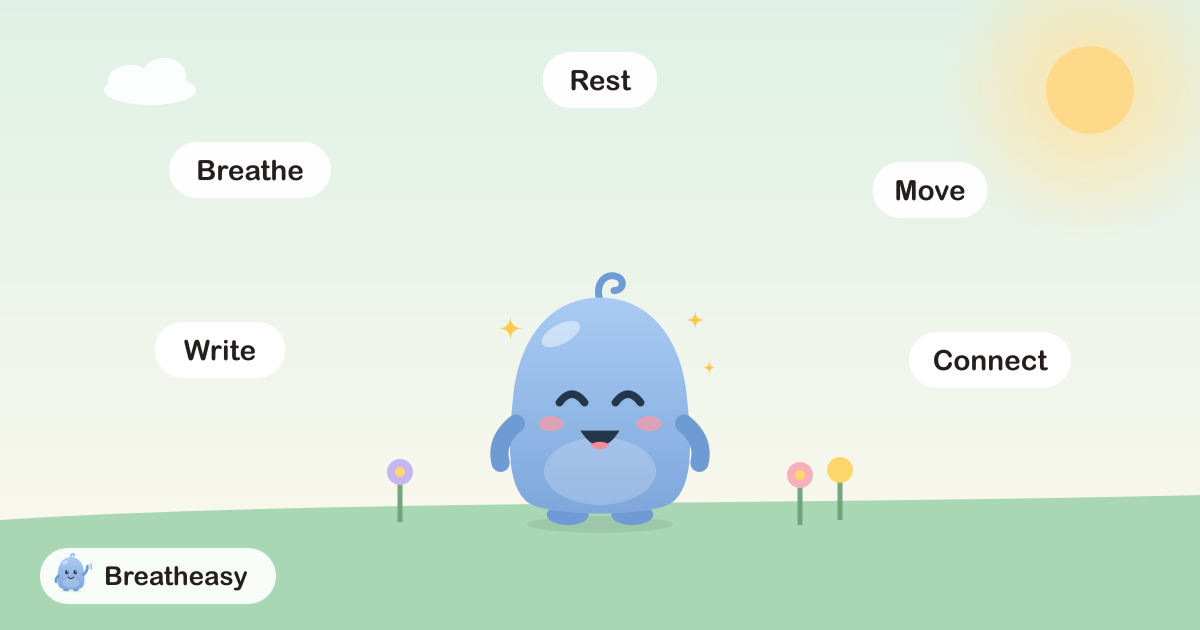
Just as physical exercise keeps your body strong, mental health exercises help keep your mind steady. They’re small, practical skills, most of them borrowed from therapies like cognitive behavioural therapy (CBT), mindfulness and behavioural activation, that you can practise anywhere.
Here are twenty, grouped by what they help with, plus a quick guide to choosing one for how you feel right now.
Which exercise should I try?
| If you feel… | Try |
|---|---|
| Panicky or wound up | Long out-breaths, grounding, cold water |
| Stuck in your head, overthinking | Worry time, thought records, “I’m having the thought that…” |
| Low, flat or unmotivated | Behavioural activation, a short walk, reaching out |
| Self-critical | The self-compassion break, the friend test |
| Overwhelmed | Brain dump, one next step |
| Can’t sleep | Progressive muscle relaxation, 4-7-8 breathing |
Exercises to calm your body
1. Long out-breaths
Breathe in through your nose for 4, out through your mouth for 6, for two to five minutes. A long out-breath slows your heart and switches on your body’s calming system. A 2023 review of 12 randomised trials found breathwork was linked to lower stress than control conditions.
2. Box breathing
In for 4, hold for 4, out for 4, hold for 4. A steady rhythm that many people find focusing. If holding your breath makes you uncomfortable, stick with long out-breaths.
3. 5-4-3-2-1 grounding
Name 5 things you can see, 4 you can feel, 3 you can hear, 2 you can smell and 1 you can taste. It pulls your attention out of worry and into the present. Our post on grounding techniques has nineteen more.
4. Progressive muscle relaxation
Working from your feet to your face, tense each muscle group for five seconds, then let go and notice the difference. Great before sleep.
5. The body scan
Lie or sit comfortably and slowly move your attention from your toes to the top of your head, noticing each area without trying to change it. It builds awareness of where you hold tension.
Exercises for your thoughts
6. Worry time
Choose a 15-minute slot each day for worrying. When a worry pops up at other times, jot it down and save it for later. Research on this kind of “stimulus control” training suggests it can help people who worry a lot. Many worries feel smaller by the time you get to them.
7. The thought record
When something upsets you, write down: the situation, what you felt (and how strongly), the thought that came up, evidence for and against it, and a more balanced thought. It’s one of the core tools of CBT.
8. “I’m having the thought that…”
When an anxious thought grabs you, like “I’m going to fail”, say to yourself: “I’m having the thought that I’m going to fail.” It creates a little distance between you and the thought, so it feels less like a fact.
9. The friend test
Ask: “What would I say to a friend who was in this situation?” Then say it to yourself. We’re often far harsher with ourselves than we’d ever be with someone else.
10. Brain dump
When your head is full, write everything down, without sorting it. Then circle just one thing to do next. Getting it out of your head frees up mental space.
Exercises for your feelings
11. Name it
Put the feeling into words: “I feel anxious,” “I feel hurt,” “I feel overwhelmed.” Naming a feeling helps take some of its intensity away and helps you respond rather than react.
12. The self-compassion break
When you’re struggling, say three things to yourself: “This is a moment of suffering.” “Struggling is part of being human.” “May I be kind to myself.” A review of 14 studies found that people with more self-compassion tend to have less anxiety, depression and stress.
13. Three good things
Each evening, write down three things that went well, big or small, and why. It gently trains your attention to notice what’s going right, not only what’s wrong.
14. Let it go
Write down something that’s weighing on you. Then close the notebook, or tear the page out. A small ritual that helps some people set a worry down for the night.
Exercises to get you moving
15. Behavioural activation
When you feel low, you wait to feel motivated before doing things. Behavioural activation flips that: you do small, planned activities first, and mood follows. Each day, schedule one thing you enjoy and one thing that gives you a sense of achievement, however small. It’s an effective, well-studied treatment for depression.
16. A 10-minute walk
Movement is one of the best-supported ways to improve mood and anxiety. A review of more than 1,000 trials found physical activity had medium-sized effects on depression and anxiety. Ten minutes outside counts.
17. Time in nature
People who spend at least two hours a week in nature tend to report better health and wellbeing. Parks, gardens, trees on your street: it all counts.
18. One small brave step
If anxiety has made you avoid something, choose the tiniest step towards it and do it. Repeat until it feels easier, then take the next step. This is the heart of exposure, one of the most effective treatments for anxiety. Our post on exposure therapy explains how it works.
Exercises for connection
19. Reach out
Send one message, make one call, or sit with someone for ten minutes. Connection is one of the strongest protectors of mental health.
20. A small act of kindness
Help someone, give a compliment, or do something kind without being asked. The NHS lists giving to others as one of its five steps to mental wellbeing.
How to make them stick
- Start with one. Pick the exercise that fits how you feel most often.
- Practise when you’re calm, so it’s easier to use when you’re not.
- Attach it to something you already do, like a breathing exercise after brushing your teeth.
- Track it. A tick on a calendar or a streak in an app helps you keep going.
- Be patient. Some exercises help within minutes; others build up over weeks.
When exercises aren’t enough
Mental health exercises are great for everyday wellbeing and alongside treatment. But if anxiety, low mood or stress has lasted more than a couple of weeks, or is affecting your work, relationships or sleep, talk to a doctor. Therapy like CBT, and sometimes medicine, help most people.
If you’re having thoughts of ending your life, call or text 988 (US) now, or call 911 in an emergency.
Frequently asked questions
What are mental health exercises?
Small, practical techniques that help you calm your body, manage your thoughts, lift your mood and connect with others. Many come from therapies like CBT and mindfulness.
What is the best mental health exercise for anxiety?
For quick relief, a long, slow out-breath (in for 4, out for 6) and grounding. For longer-term change, gradually facing what you avoid, worry time and regular physical activity.
How often should I do mental health exercises?
A few minutes every day is more helpful than a long session once a week. Short, regular practice builds the habit and makes the skills easier to use when you need them.
Can mental health exercises replace therapy?
They can help a lot, especially for everyday stress. But for an anxiety disorder, depression or trauma, they work best alongside professional treatment, not instead of it.
How Breatheasy can help
We built Breatheasy to be the easiest way to practise mental health exercises every day, so we’d suggest it first. It brings many of these exercises into one free app: long out-breaths, box breathing and 4-7-8 with your phone pulsing gently as you breathe in, 5-4-3-2-1 grounding, a tool for riding out urges, ten-second check-ins and a journal with questions like “What went well today?” and “Is something weighing on you?”. Gentle daily steps and a kind streak, with a free rest day each week, help you keep going. When anxiety spikes, tap “I’m feeling anxious” and Luma walks you through it. Breatheasy is coming soon to iPhone and Android.
Sources
- Effect of breathwork on stress and mental health: a meta-analysis of randomised-controlled trials, Fincham and others, Scientific Reports, 2023
- A preliminary investigation of stimulus control training for worry, McGowan and Behar, Behavior Modification, 2013
- Exploring compassion: a meta-analysis of the association between self-compassion and psychopathology, MacBeth and Gumley, Clinical Psychology Review, 2012
- Behavioural activation for depression: an update of meta-analysis, Ekers and others, PLoS One, 2014
- Effectiveness of physical activity interventions for improving depression, anxiety and distress, Singh and others, British Journal of Sports Medicine, 2023
- Spending at least 120 minutes a week in nature is associated with good health and wellbeing, White and others, Scientific Reports, 2019
- 5 steps to mental wellbeing, NHS