Breatheasy
How to sleep with anxiety: what actually helps when your mind won’t switch off
Practical, evidence-based ways to fall asleep and stay asleep when anxiety keeps you up, including the techniques from CBT for insomnia, what to do with racing thoughts, and the truth about sleep aids.
 Breatheasy team27 October 2026 · 7 min read
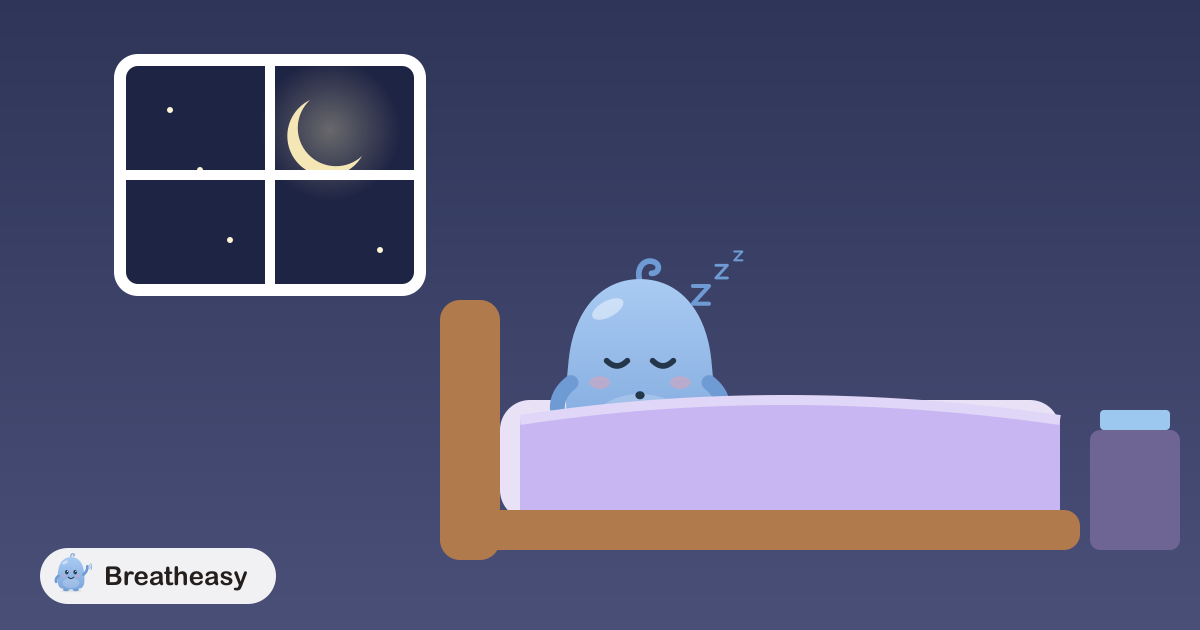
You’re exhausted. But the moment your head hits the pillow, your mind lights up: tomorrow’s meeting, that awkward conversation, the bills, what if, what if. Hours later, you’re still awake, and now you’re anxious about not sleeping too.
Anxiety and poor sleep feed each other. The good news is that the techniques that work best for long-term sleep problems also work well when anxiety is the cause.
Why anxiety keeps you awake
- Your alarm system is switched on. Anxiety keeps adrenaline and alertness high, which is the opposite of what your body needs to sleep.
- Quiet makes worries louder. At night there are no distractions, so your thoughts take centre stage.
- Trying hard to sleep backfires. Sleep comes when you let go. Effort and pressure keep you awake.
- Your brain learns to link bed with worry. After many nights lying awake, simply getting into bed can make you more alert.
Our post on why anxiety is worse at night explains more.
Before bed: give worries somewhere else to go
- Have a “worry time” in the early evening. Spend 15 minutes writing down what’s on your mind and one next step for each worry. Then close the notebook. If a worry comes up later, remind yourself it has a time slot.
- Write tomorrow’s to-do list before you start winding down, so your brain doesn’t need to hold onto it.
- Wind down for an hour. Dim the lights, put work and news away, and do something calm: a warm shower, gentle stretching, reading, music.
- Keep screens calm. If you use your phone, avoid news, email and social media. Choose something soothing instead, or put it away.
In bed: let sleep come to you
- Go to bed when you feel sleepy, not just tired. Sleepy is the heavy-eyelid, yawning feeling.
- Relax your body. Try progressive muscle relaxation: tense each muscle group for a few seconds, then let it go, working from your feet to your face.
- Slow your breathing. Breathe in through your nose for 4 and out for 6, or try 4-7-8 breathing: in for 4, hold for 7, out for 8. Our post comparing calm, box and 4-7-8 breathing explains each one.
- Give your mind something gentle to do. Picture a calm place in detail, listen to soft sounds like rain, or a slow story.
- Don’t clock-watch. Turn the clock around. Working out how little sleep you’ll get adds a fresh worry.
If you can’t sleep: get up
This is one of the most effective, and least popular, pieces of advice.
If you’ve been lying awake for about 20 minutes (roughly, no need to check), get up. Go somewhere calm and dim. Read something gentle, listen to quiet audio, or do slow breathing. Go back to bed when you feel sleepy. Repeat as needed.
It feels like you’re losing sleep. But it teaches your brain that bed is for sleeping, not for lying awake worrying. It’s called stimulus control, and it’s a core part of CBT for insomnia.
During the day: set up tonight’s sleep
- Get up at the same time every day, including weekends, even after a bad night. This anchors your body clock.
- Get daylight in the morning, ideally outside.
- Keep caffeine to the morning. In one study, caffeine taken 6 hours before bed still disrupted sleep.
- Go easy on alcohol. It can help you drop off, but makes sleep lighter and more broken later in the night, and can leave you anxious the next day.
- Move your body during the day. If vigorous exercise late in the evening keeps you wired, move it earlier.
- Keep naps short and early, or skip them, so you’re sleepy at bedtime.
CBT for insomnia (CBT-I)
If you’ve had trouble sleeping on at least 3 nights a week for 3 months or more, that’s chronic insomnia. The American Academy of Sleep Medicine strongly recommends cognitive behavioural therapy for insomnia (CBT-I) as the treatment for chronic insomnia. It usually includes:
- stimulus control, like the get-up rule above
- sleep restriction, temporarily limiting time in bed to build up your natural sleep drive, then gradually extending it (best done with guidance)
- working with thoughts about sleep, like “I’ll never cope tomorrow”
- relaxation techniques
- habits that support sleep
CBT-I is available from trained therapists, and some digital programmes are based on it. Ask your doctor.
What about sleep aids?
- Over-the-counter sleep aids often contain antihistamines. They can leave you groggy the next day, they become less effective with regular use, and they’re generally not recommended for older adults.
- Melatonin helps some sleep problems linked to timing, like jet lag. The evidence for regular insomnia is limited, and the amount in supplements can vary from what’s on the label. The US National Center for Complementary and Integrative Health has a helpful guide.
- Prescription sleeping tablets are usually only for short periods. Some, like benzodiazepines, can cause dependence.
- Alcohol is not a sleep aid, for the reasons above.
Talk to a doctor or pharmacist before using any sleep aid, especially if you take other medicines.
When to see a doctor
See a doctor if:
- you’ve slept badly for 3 months or more
- poor sleep is affecting your days, mood or safety, such as feeling drowsy while driving
- you snore loudly, wake up gasping or choking, or feel very sleepy in the day, which can be signs of sleep apnea
- you have an urge to move your legs at night (restless legs)
- you wake very early with low mood and can’t get back to sleep, which can be a sign of depression
If you wake up in a panic, our post on how to calm an anxiety attack at night has a step-by-step plan.
Frequently asked questions
How can I fall asleep fast with anxiety?
There’s no switch, but you can make it easier: write your worries down earlier in the evening, wind down for an hour, relax your muscles one group at a time, slow your breathing and listen to something soft. If you’re still wide awake after about 20 minutes, get up until you feel sleepy.
Should I stay in bed if I can’t sleep?
Not for long. Lying awake for hours teaches your brain to link bed with being awake and worried. Get up after about 20 minutes, do something calm in dim light, and go back to bed when you feel sleepy.
Is it okay to listen to something to fall asleep?
Yes, for most people. Steady sounds like rain or waves, or a slow, gentle story, give your mind something soft to rest on instead of your worries. Keep the volume low.
Does melatonin help anxiety?
Melatonin isn’t a treatment for anxiety, and the evidence for it in ordinary insomnia is limited. It can help with jet lag and some body-clock problems. Talk to a pharmacist before taking it.
How Breatheasy can help
Breatheasy has a Sleep space to help you wind down. Fall asleep to calming sleep sounds like rain and waves, or a bedtime story read by Luma, or try 4-7-8 breathing with your phone pulsing gently as you breathe in. If you wake in a panic, tap “I’m feeling anxious” and Luma walks you through it. Breatheasy is coming soon to iPhone and Android.
Sources
- Behavioral and psychological treatments for chronic insomnia disorder in adults: an AASM clinical practice guideline, Edinger and others, Journal of Clinical Sleep Medicine, 2021
- Insomnia, NHS
- Melatonin: what you need to know, National Center for Complementary and Integrative Health
- Caffeine effects on sleep taken 0, 3, or 6 hours before going to bed, Drake and others, Journal of Clinical Sleep Medicine, 2013
- Sleep apnoea, NHS
- Hangovers, National Institute on Alcohol Abuse and Alcoholism