Breatheasy
Do I have panic disorder? A quick self-check
Six questions, based on how doctors recognise panic disorder, to help you understand your panic attacks. It isn’t a diagnosis, but it can help you decide whether to talk to a doctor.
 Breatheasy team27 October 2026 · 3 min read
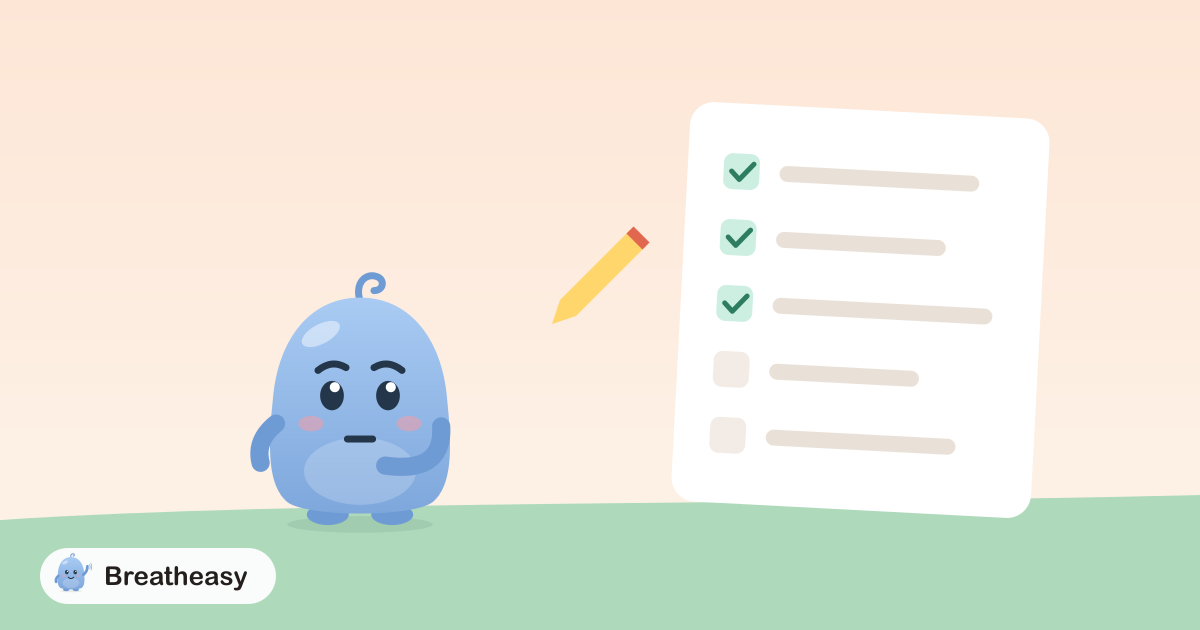
If you’ve had a panic attack, or several, you may be wondering whether it’s something more. This short self-check is based on how doctors recognise panic disorder. It can’t give you a diagnosis, but it can help you understand what’s happening and decide whether to talk to someone.
First: panic attacks aren’t the same as panic disorder
Panic attacks are common. Many people have one or two in their lives, often during a stressful time, and never have another. Panic disorder is when panic attacks keep happening, out of the blue, and the fear of them starts to shape your life.
The self-check
Think about the past few months. Answer each question with a simple yes or no.
- Have you had sudden surges of intense fear or discomfort that peaked within minutes? For example, with a racing heart, breathlessness, shaking, sweating, dizziness, tingling, chest pain or a fear of dying or losing control.
- Has this happened more than once?
- Have some of these attacks come out of the blue, without an obvious trigger, or even woken you from sleep?
- For a month or more after an attack, have you worried a lot about having another one, or about what the attacks might mean, like having a heart attack or “going crazy”?
- Have you changed what you do because of the attacks? For example, avoiding exercise, driving, stores, crowds or being alone, or always carrying something “just in case”.
- Are the attacks causing you distress, or getting in the way of your work, relationships or daily life?
What your answers might mean
If you answered “yes” to questions 1, 2 and 3, and to question 4 or 5: your experience sounds like it could be panic disorder. Please talk to a doctor. Panic disorder is common and very treatable.
If you answered “yes” to question 1 only: you’ve had panic attacks, but they may not be part of panic disorder. If they’re worrying you, it’s still worth mentioning them to a doctor.
If you answered “yes” to question 5: avoiding places or activities because of panic can grow over time. Getting support early helps stop it spreading.
Whatever your answers: if you’re struggling, you deserve support. You don’t need a diagnosis to ask for help.
What a doctor will do
A doctor will ask about your panic attacks, how often they happen and how they affect your life. They may also do some checks, like your heart and thyroid, to rule out physical causes of symptoms like a racing heart or breathlessness. Some doctors and therapists use a questionnaire called the Panic Disorder Severity Scale to measure how much panic is affecting you, and to track progress.
If it is panic disorder
Panic disorder is one of the most treatable anxiety problems. Cognitive behavioural therapy (CBT) helps most people, and some people are also offered medicine, usually an antidepressant called an SSRI. Read Panic disorder therapy to find out what treatment involves.
How Breatheasy can help
Whatever your answers, Breatheasy can help you get through panic attacks and understand them. Tap “I’m feeling anxious” and Luma walks you through it: rate how strong it feels, breathe slowly as your phone pulses gently, ground yourself with 5-4-3-2-1, then see how far the anxiety came down. Over time, your journal builds a record of your panic attacks and what set them off, which can be really helpful to share with a doctor. Breatheasy is coming soon to iPhone and Android.
When to get help
Talk to a doctor if panic attacks keep happening, if you’re worrying about the next one, or if you’re avoiding things because of them. Our guide to anxiety and panic attacks is a good place to start.
If you have chest pain that spreads to your arm, jaw, neck or back, or you’re struggling to breathe, call 911. If you’re in crisis, call or text 988.
Sources
- Panic disorder, NHS
- Panic Disorder: When Fear Overwhelms, National Institute of Mental Health
- Panic attacks and panic disorder, Cleveland Clinic