Breatheasy
Anxiety attack symptoms: what they feel like, and what to do
The body, feeling and thinking signs of an anxiety attack, how it differs from a panic attack, how long it lasts, and the symptoms that need a doctor.
 Breatheasy team27 October 2026 · 8 min read
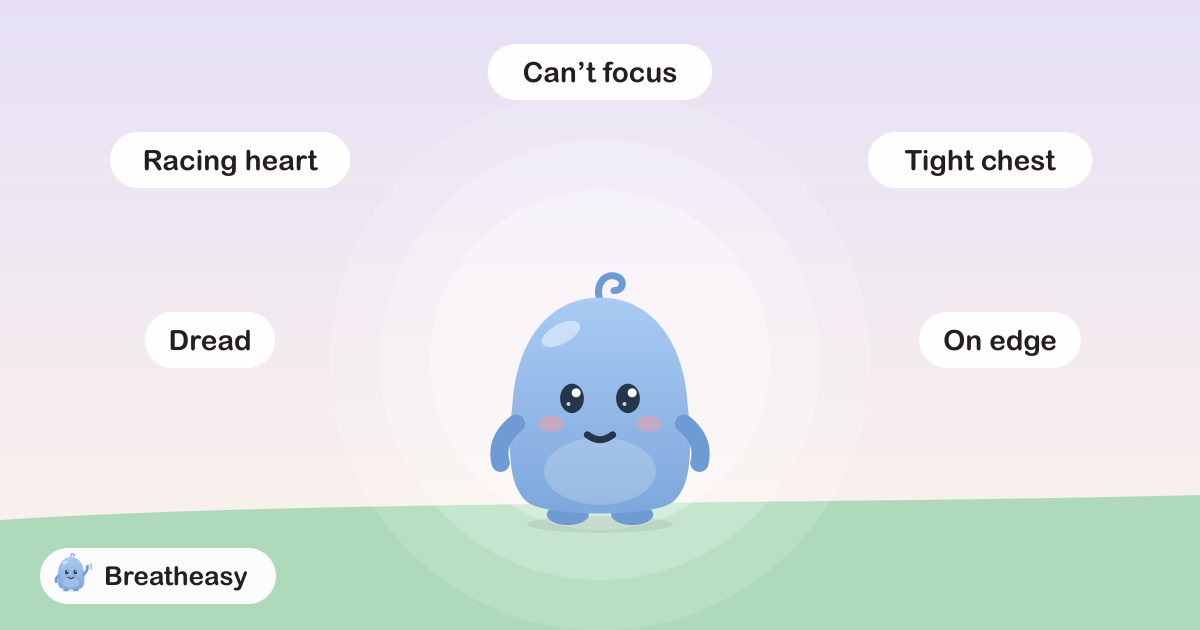
Your heart is pounding, your chest feels tight and your thoughts won’t slow down. You might feel shaky, sick or strangely far away. It’s frightening, and it’s natural to wonder what’s happening to you.
“Anxiety attack” is how many people describe this. It isn’t an official diagnosis, but the symptoms are very real and very common. Here’s what they are, what they mean, and what helps.
If you have chest pain that spreads to your arm, jaw, neck or back, you’re struggling to breathe, or you feel faint, call 911 (or your local emergency number) now. It’s always okay to get checked.
What people mean by an “anxiety attack”
Doctors use the term panic attack for a sudden surge of intense fear that peaks within minutes. “Anxiety attack” is an everyday phrase, and people use it for two slightly different experiences:
- A panic attack: fear that hits suddenly, sometimes out of the blue, with strong body symptoms.
- A build-up of intense anxiety: worry and tension that grow over minutes or hours, often about something specific, until it feels overwhelming.
The symptoms overlap a lot, and the same things help with both. Our post on panic attacks vs anxiety attacks explains the difference in more detail.
Body symptoms
Anxiety switches on your body’s fight-or-flight response. Adrenaline gets you ready to run or fight, even when there’s nothing to run from. That’s why so many anxiety attack symptoms are physical:
- Heart and chest: a racing, pounding or skipping heartbeat, a tight or heavy chest, chest pain
- Breathing: feeling short of breath, breathing fast, not being able to get a full breath, yawning or sighing a lot
- Head: dizziness, light-headedness, headaches, a fuzzy or “not quite here” feeling
- Stomach: nausea, butterflies, churning, needing the toilet
- Temperature and skin: sweating, hot flushes or chills, tingling or numbness, often in your hands, feet or around your mouth
- Muscles: shaking or trembling, tense shoulders and jaw, aching, feeling weak or wobbly
- Mouth and throat: a dry mouth, a lump in your throat, finding it hard to swallow
Feelings
- a sense of dread, or that something awful is about to happen
- feeling on edge, wound up or unable to relax
- fear of losing control, “going mad” or dying
- irritability, or wanting to cry
- feeling detached from yourself or from the world around you
That last one can be one of the scariest symptoms. It’s called depersonalization or derealization, and our post on what derealization feels like explains why it happens.
Thinking symptoms
- racing thoughts, or thoughts that jump from one worry to the next
- “what if” thinking and imagining the worst
- your mind going blank
- finding it hard to concentrate, follow a conversation or make decisions
- being hyper-aware of every body sensation
What you might do
Anxiety changes behaviour too. During or after an attack, you might:
- feel a strong urge to escape or get somewhere “safe”
- pace, fidget or be unable to sit still
- check your pulse, search your symptoms or ask people for reassurance
- avoid the place or situation where it happened
These urges make total sense. But avoiding and checking can keep anxiety going in the long run, which is why treatment gently helps you do less of them.
Sudden or slow: two kinds of anxiety attack
| Panic attack | Building anxiety | |
|---|---|---|
| How it starts | Suddenly, sometimes for no clear reason | Gradually, often with a worry or a stressful situation |
| Peak | Within minutes, usually about 10 | Can build over hours |
| How long | Most last 5 to 20 minutes | Can last hours, rising and falling |
| What stands out | Intense fear and strong body symptoms | Worry, tension, restlessness and dread |
| Afterwards | Drained and shaky | Tired, tense and on edge |
Many people have both at different times. Our post on how long anxiety attacks last goes into timing in more detail.
What to do during an anxiety attack
- Name it. Say to yourself: “This is anxiety. It feels awful, but it isn’t dangerous, and it will pass.”
- Breathe out slowly. In through your nose for 4, out through your mouth for 6. The long out-breath is your body’s brake pedal.
- Drop your shoulders and unclench your jaw. Tense muscles send “danger” signals back to your brain.
- Ground yourself. Name 5 things you can see, 4 you can feel, 3 you can hear, 2 you can smell and 1 you can taste.
- Let it come and go. Fighting the feelings tends to make them bigger. Imagine them as a wave you can float over.
- Stay where you are if you can. Leaving is okay, but staying teaches your brain that you can cope.
For a fuller guide, see how to stop a panic attack.
After an anxiety attack
It’s normal to feel exhausted, achy, a bit low or jumpy for hours afterwards. Adrenaline takes time to clear. Rest, drink some water, eat something light and go easy on yourself. Our post on the panic attack hangover explains why it happens.
Is it anxiety, or something else?
Some health problems cause symptoms that feel a lot like anxiety, including an overactive thyroid, heart rhythm problems, asthma, low blood sugar in people with diabetes, and allergic reactions. So can caffeine, energy drinks, some medicines (like steroids, asthma inhalers and decongestants), and coming off alcohol or drugs.
Call 911 (or your local emergency number) if you have:
- chest pain or pressure that spreads to your arms, back, neck or jaw
- severe difficulty breathing, or blue or grey lips
- fainting, or feeling like you’re about to pass out
- sudden weakness or numbness on one side, a drooping face or slurred speech
- swelling of your lips, tongue or throat
See a doctor soon if:
- it’s the first time you’ve had symptoms like these
- your symptoms are different from your usual anxiety
- you’re having attacks often, or they’re getting worse
A check-up is never a waste of time. Normal results make it easier to trust, next time, that it’s anxiety.
When to get help
If anxiety attacks keep happening, or you’re starting to avoid things because of them, talk to a doctor. Anxiety is very treatable. Cognitive behavioural therapy (CBT) is one of the most effective treatments, and some people are offered medicine too. A doctor might ask you to fill in a short questionnaire called the GAD-7, which measures how much anxiety has bothered you over the last two weeks.
If you’re having thoughts of ending your life, please call or text 988 (US) now.
Frequently asked questions
Can an anxiety attack last for days?
A single surge of panic doesn’t. Your body can’t keep up that level of adrenaline for long. But anxiety can stay high for days, coming in waves, especially during a stressful time. If you feel anxious most days for weeks, it’s worth talking to a doctor about generalised anxiety.
Can you have an anxiety attack for no reason?
Yes. Panic attacks often seem to come out of nowhere, and that’s part of what makes them so frightening. There’s usually a trigger you didn’t notice, like a body sensation, tiredness or built-up stress. Our post on panic attacks for no reason explains more.
Can an anxiety attack hurt you?
An anxiety attack feels dangerous, but in someone who is otherwise healthy, it isn’t harmful. Your body is designed to handle adrenaline. That said, new or different symptoms should always be checked, because anxiety and a physical problem can happen at the same time.
Can you have an anxiety attack in your sleep?
Yes. Waking up suddenly in a panic is called a nocturnal panic attack, and it’s common in people who have panic attacks during the day. Our post on how to calm an anxiety attack at night has a step-by-step plan.
How Breatheasy can help
Breatheasy helps with anxiety attack symptoms in the moment. Tap “I’m feeling anxious” and Luma walks you through it: rate how strong it feels from 1 to 10, breathe slowly as your phone pulses gently, ground yourself with 5-4-3-2-1, then see how far the anxiety came down. It works without internet, and it’s always free. Every two weeks, Breatheasy also offers a short anxiety check using the GAD-7, so you can see how you’re doing over time and share it with a doctor if you’d like. Breatheasy is coming soon to iPhone and Android.
Sources
- Panic disorder, NHS
- Generalised anxiety disorder in adults, NHS
- Get help with anxiety, fear or panic, NHS
- Anxiety disorders, National Institute of Mental Health
- Panic Disorder: What You Need to Know, National Institute of Mental Health