Breatheasy
A journal for social anxiety: 5 diary techniques from CBT that actually help
How to use a diary or journal app for social anxiety: prediction logs, thought records, spotting safety behaviours, a kinder way to replay conversations, and prompts to get you started, plus what to look for in a diary app.
 Breatheasy team27 October 2026 · 6 min read
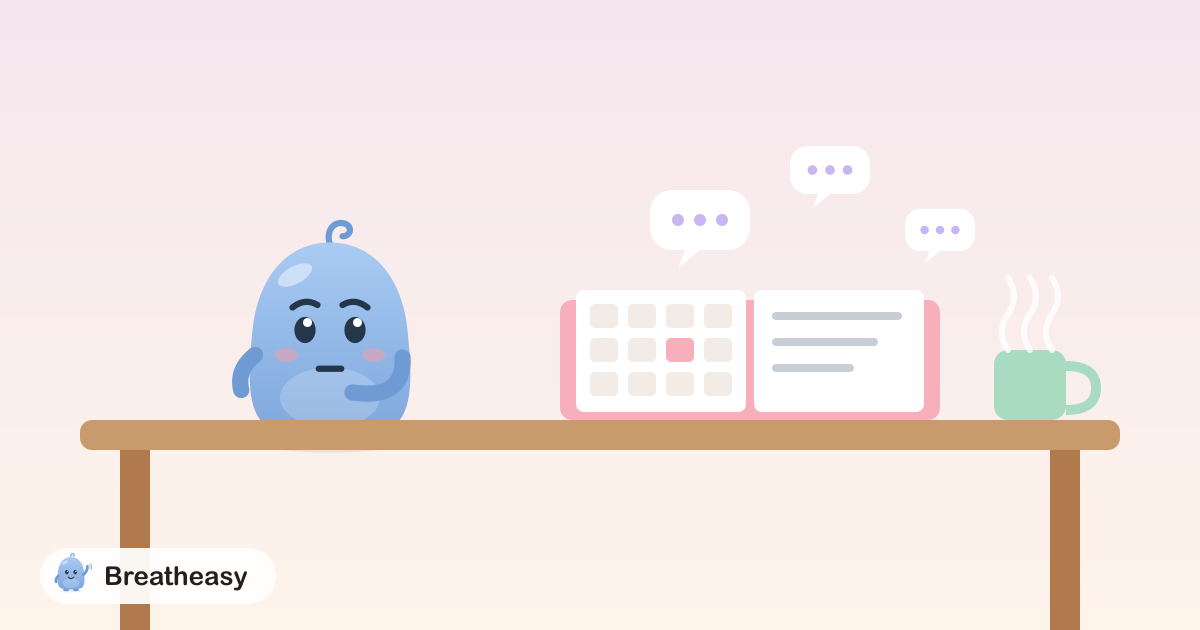
You replay the conversation on the way home. Did I say something stupid? Did they notice my hands shaking? Why did I laugh like that? Hours later, you’re still going over it.
If that sounds familiar, a journal can help, but only if you use it in the right way. Here are five diary techniques drawn from cognitive behavioural therapy (CBT) for social anxiety, plus prompts to get you started.
The social anxiety cycle
Social anxiety tends to follow a pattern:
- Before: worry and imagining everything that could go wrong
- During: focusing intensely on yourself (how you look, sound and seem), and doing things to feel safer, like avoiding eye contact, rehearsing what to say or holding a drink to hide shaking
- After: replaying the situation in detail and picking out everything that felt awkward, often called the post-mortem
Each stage feeds the next. A journal can break the cycle at every point.
1. Keep a prediction log
This is one of the most powerful tools in CBT for social anxiety.
Before a social situation, write:
- What I’m afraid will happen: “Everyone will notice I’m blushing and think I’m weird.”
- How strongly I believe it, from 0 to 100%.
Afterwards, write:
- What actually happened
- How it compares with my prediction
- What I learned
Over time, you’ll build a record showing that your predictions are usually far worse than reality, and that when awkward moments happen, you cope.
2. Use a thought record
When anxiety spikes, write down:
- The situation: “Team meeting, my turn to speak.”
- What I felt, and how strongly (0 to 10).
- The thought: “They think I don’t know what I’m talking about.”
- Evidence for and against that thought.
- A more balanced thought: “I stumbled on one word. Most people were looking at the slides. My manager nodded.”
3. Spot your safety behaviours
Safety behaviours feel protective, but they keep social anxiety going. They also make you more self-focused, which can make you seem more distant to others. Write down what you did to feel safe, for example:
- rehearsing sentences in your head
- avoiding eye contact
- staying near the door or on your phone
- keeping quiet, or talking too fast
- having a drink to calm your nerves
Then choose one to drop next time, and note what happens in your prediction log.
4. Replace the post-mortem with a short, kind review
Replaying a conversation for hours makes it feel worse, because you only remember the awkward bits. Instead, give it ten minutes on paper:
- What went okay?
- What would a kind friend say about how it went?
- What do I actually know, and what am I guessing about what people thought?
- What’s one thing I’d like to try next time?
Then close the journal. If the replay starts again, remind yourself: “I’ve reviewed it. It’s done.”
5. Record your brave steps
Every time you do something social anxiety tells you not to, like speaking up, saying hello or going to the event, write it down. Over weeks, this list becomes powerful evidence that you’re more capable than anxiety says.
Journal prompts for social anxiety
- What am I predicting will happen, and how sure am I?
- What actually happened?
- What would I tell a friend who felt this way?
- What did I do to feel safe? What happens if I try without it?
- What went well today, socially or otherwise?
- What’s one small brave step I could take this week?
- Is something weighing on me that I can write down and let go?
What to avoid
- Turning the journal into a rumination diary. If you find yourself writing pages about how badly something went, switch to the short, kind review.
- Only rereading the bad entries. Read your brave steps and predictions that didn’t come true too.
- Using it to plan avoidance. Use it to plan small steps forward instead.
What to look for in a diary app
- Privacy. Check whether the app sells data, shows ads or uses tracking. Your journal is personal.
- Quick to use. If writing takes too long, you won’t do it.
- Prompts, so you’re not facing a blank page.
- Mood tracking and patterns, so you can see what helps and what makes things harder.
- Control over your data, including backup and the ability to delete everything.
How the Breatheasy journal can help
Breatheasy has a journal designed for exactly this kind of reflection:
- A quick daily check-in: rate how anxious you feel, pick from 16 feelings drawn as Luma’s faces, and tag what affected your day, like relationships, seeing friends or social media.
- One gentle question at a time: “Anything on your mind today?”, “What went well today, big or small?”, “Is something weighing on you? Write it down and let it go.” and “What are you grateful for today?”
- A diary you’ll want to open: your entries live in an illustrated calendar, and you can star the days you want to remember, like a brave step.
- After a panic attack, note what set it off, such as a social situation, so patterns become clear.
- Patterns and insights (Premium) show what tends to help and what makes things harder.
Privacy: Breatheasy doesn’t sell your data, show you ads or use advertising or analytics trackers. Your journal is backed up to your account so you don’t lose it, and you can delete it all from inside the app at any time.
When anxiety spikes before or during a social situation, tap “I’m feeling anxious” and Luma walks you through slow breathing and grounding. Breatheasy is coming soon to iPhone and Android.
When to get help
Writing helps, but social anxiety disorder is a common condition that responds best to treatment. The UK’s National Institute for Health and Care Excellence (NICE) recommends individual CBT designed specifically for social anxiety as the first treatment for adults. Talk to a doctor if social anxiety is stopping you from working, studying, making friends or doing things you want to do. Our post on social anxiety disorder symptoms explains more.
If you’re having thoughts of ending your life, call or text 988 (US) now.
Frequently asked questions
Does journaling help social anxiety?
It can, especially when you use CBT-based techniques like prediction logs and thought records, rather than just venting. It works best alongside treatment like CBT.
What should I write in a social anxiety journal?
Your predictions before social situations and what actually happened, your anxious thoughts and more balanced alternatives, the things you did to feel safe, and your brave steps.
How do I stop replaying conversations?
Give the replay a short, scheduled slot on paper: ten minutes to note what went okay, what a kind friend would say, and one thing to try next time. Then close the journal and do something absorbing.
Is a diary app better than a paper journal?
Either works. Apps can make it quicker, add prompts and show patterns over time. Paper can feel more private and less distracting. Choose whichever you’ll actually use.
Sources
- Social anxiety disorder: recognition, assessment and treatment (CG159), National Institute for Health and Care Excellence
- Social anxiety disorder statistics, National Institute of Mental Health
- Cognitive behavioural therapy (CBT), NHS
- Privacy policy, Breatheasy