Breatheasy
What are the five stress levels? A simple guide to where you are, and what to do
There’s no single official scale of stress, but there are useful ways to see where you are. A simple five-level guide built on the stress continuum used by the US military and health care, the signs at each level and what helps.
 Breatheasy team27 October 2026 · 5 min read
“How stressed am I, really?” It’s a good question, and harder to answer than it sounds. Stress creeps up gradually, and it’s easy to keep going until something gives.
You may have seen lists of “five stress levels” or “five stages of stress” online. There isn’t a single official scale. But there are useful models, and a simple guide can help you see where you are and what to do next.
Models of stress
The stress continuum: four colour zones
Developed for the US military and now used widely in health care, the stress continuum describes four zones, like a traffic light. The American Medical Association describes it as a color-coded tool that gives people a shared language for stress and helps reduce stigma.
- Green: ready. Coping well, functioning, doing well.
- Yellow: reacting. Mild, temporary distress or changes in how you function, usually from everyday stress. It passes as things settle.
- Orange: injured. More severe or lasting distress or changes that don’t go away when the pressure eases, often after trauma, loss or prolonged strain.
- Red: ill. Distress that has become a health condition, like depression, an anxiety disorder, PTSD or a substance use problem.
People move between zones over time, in both directions.
Selye’s three stages
In the 1930s, the scientist Hans Selye described how the body responds to ongoing stress in three stages: an alarm reaction, a stage of resistance where the body adapts, and eventually exhaustion if the stress goes on too long.
“Five stages of burnout”
You may also see a popular five-stage burnout model online. It can be a helpful way to describe how stress builds, but it isn’t an established scientific scale.
A simple five-level guide
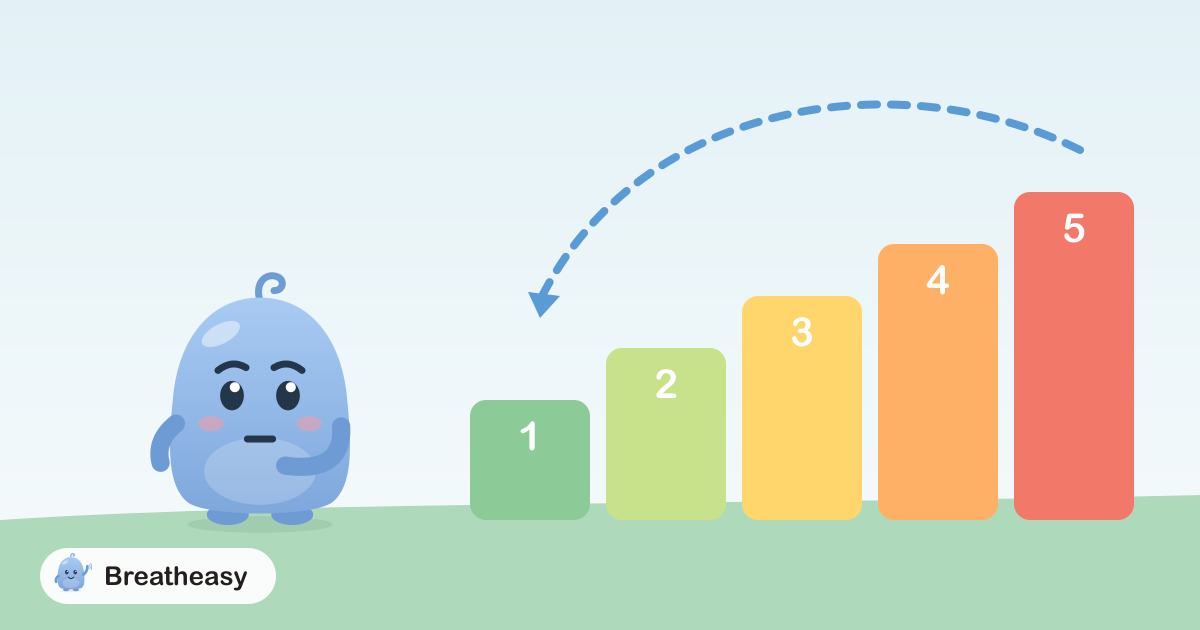
Here’s a practical way to check in with yourself, built on the stress continuum. It isn’t a medical scale, just a guide.
| Level | How it feels | What helps |
|---|---|---|
| 1. Calm | Rested, steady, coping well | Keep up what’s working: sleep, movement, connection |
| 2. Alert | Busy or challenged, but energised and in control | Healthy pressure. Build in breaks and rest |
| 3. Strained | Tense, irritable, sleeping less well, harder to switch off | Act now: slow breathing, sleep, cut back where you can, talk to someone |
| 4. Overloaded | Constantly on edge, exhausted, headaches or stomach trouble, struggling to cope | Make real changes, ask for help, and consider talking to a doctor |
| 5. Burnout or crisis | Can’t function as usual, hopeless, panic attacks, drinking to cope, or thoughts of self-harm | Get professional support now. If you’re in crisis, call or text 988 |
Levels 1 and 2 are like the green zone, level 3 is yellow, level 4 is orange, and level 5 overlaps with red.
Signs your stress is rising
- sleeping badly, or waking early with your mind racing
- tight shoulders, headaches or jaw clenching
- irritability or snapping at people
- withdrawing from friends or things you enjoy
- relying more on caffeine, alcohol, sugar or screens
- feeling you can never switch off
Our post on the physical signs of stress lists twenty more.
What to do at each level
- Green (levels 1 and 2): protect the basics. Sleep, movement, time outdoors and people you enjoy keep you resilient.
- Yellow (level 3): this is the best moment to act. Slow breathing, a walk, an earlier night, saying no to one thing, or talking to someone can turn things around quickly.
- Orange (level 4): small fixes aren’t enough. Look at what’s driving the stress, like workload, caring, money or relationships, and get support. Talk to your doctor if it’s affecting your health or sleep.
- Red (level 5): you deserve professional help. Talk to a doctor or therapist. If you’re thinking about ending your life, call or text 988 (US) now, or call 911 in an emergency.
Our guide to stress reduction techniques has fifteen ideas to try.
Burnout
The World Health Organization describes burnout as the result of chronic workplace stress that hasn’t been successfully managed. It shows up as exhaustion, feeling cynical or detached from your job, and feeling less effective. It often means the problem is the situation, not you, and changes at work are part of the fix.
Frequently asked questions
What are the 5 levels of stress?
There’s no single official scale. A simple guide is: calm, alert, strained, overloaded, and burnout or crisis. The widely used stress continuum describes four zones: ready (green), reacting (yellow), injured (orange) and ill (red).
What are the 3 stages of stress?
Hans Selye described three stages of the body’s response to ongoing stress: alarm, resistance and exhaustion.
How do I know my stress level?
Notice your sleep, energy, mood, body and behaviour. If you’re sleeping badly, irritable, tense and finding it hard to switch off, you’re probably in the “strained” or yellow zone, and it’s a good time to act.
When is stress too much?
When it lasts, overwhelms your ability to cope, affects your health or sleep, or leads you to drink or withdraw. That’s the time to make changes and get support.
How Breatheasy can help
Breatheasy can help you notice your stress level before it climbs. Ten-second check-ins let you rate how you feel each day and see patterns over time, so you can catch the yellow zone early. One-minute breathing exercises pulse your phone gently as you breathe in, and if stress tips into anxiety or panic, tap “I’m feeling anxious” and Luma walks you through it. Breatheasy is coming soon to iPhone and Android.
Sources
- How to identify a stress injury in a physician colleague, American Medical Association
- A syndrome produced by diverse nocuous agents, Selye, Nature, 1936
- Burn-out an “occupational phenomenon”, World Health Organization
- I’m so stressed out! Fact sheet, National Institute of Mental Health
- Stress, NHS