Breatheasy
What is OCD, and what causes it?
OCD (obsessive-compulsive disorder) explained: what it means, the obsessions and compulsions cycle, what research says about its causes, including genes, the brain, stress and infections in children, and how it’s managed and treated.
 Breatheasy team27 October 2026 · 5 min read
OCD is one of the most talked-about and least understood mental health conditions. People say “I’m so OCD” about liking things tidy. But real OCD is very different, and it can be exhausting.
Here’s what OCD actually is, what research says about its causes, and how it’s treated.
What is OCD?
Obsessive-compulsive disorder (OCD) is a mental health condition with two parts:
- Obsessions: unwanted, intrusive thoughts, images, urges or doubts that cause anxiety, disgust or distress.
- Compulsions: repeated actions or mental rituals done to reduce that distress or prevent something bad from happening.
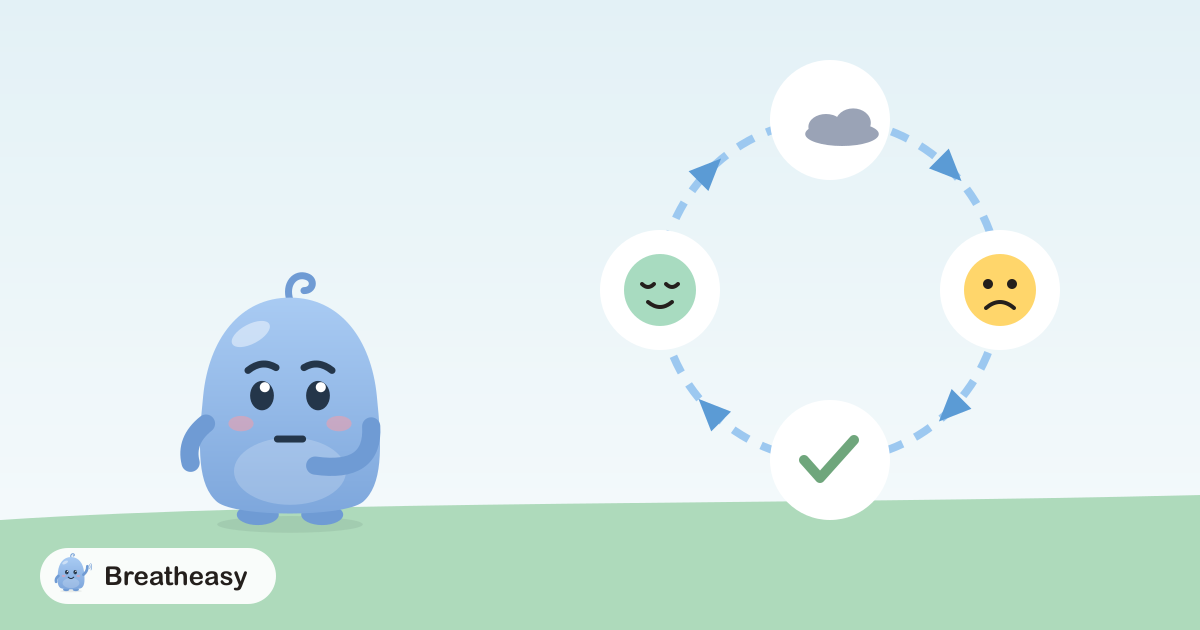
The cycle looks like this:
- An obsession pops up: “What if I didn’t lock the door?”
- Anxiety follows.
- A compulsion brings relief: checking the lock.
- Relief teaches your brain the obsession was important.
- The cycle repeats, often getting stronger.
For it to be OCD, the cycle usually takes up a lot of time (often more than an hour a day), causes distress or gets in the way of life. About 1.2% of US adults have OCD in a given year, and about 2.3% at some point in their lives.
Common types
OCD can attach to almost anything, but common themes include contamination, checking, symmetry and “just right” feelings, and unwanted thoughts about harm, sex or religion. Our post on the types of OCD explains each.
What causes OCD?
There’s no single cause. Research points to a combination of factors:
Genes
OCD tends to run in families. Having a close relative with OCD makes it more likely, though it doesn’t mean you’ll definitely develop it.
The brain
Brain imaging studies have found differences in the circuits that link the front of the brain, involved in planning and judgment, with deeper areas involved in habits and alarm signals. These differences may make it harder to switch off a sense that something is wrong.
Temperament
People who are naturally cautious, conscientious or sensitive to responsibility and doubt may be more prone to OCD.
Stress and life events
Stressful or traumatic experiences, big life changes and becoming a parent can trigger OCD or make it worse in people who are already vulnerable.
Infections in children
In a small number of children, OCD symptoms start very suddenly after an infection, such as a strep throat infection. This is studied under the names PANDAS and PANS. If OCD symptoms appear very suddenly in a child, see a doctor promptly.
What doesn’t cause OCD
- Bad parenting. Family patterns can affect how OCD shows up, but parents don’t cause it.
- Weakness or lack of willpower. OCD isn’t something you can just stop.
- Being tidy or organised. Liking order isn’t OCD.
How OCD is treated
- Exposure and response prevention (ERP): a form of CBT where you gradually face your triggers while resisting compulsions. It’s the most effective psychological treatment for OCD.
- Medicine: SSRIs can help, sometimes at higher doses than for depression.
- Both together, for many people.
How to manage OCD day to day
- Name it: “That’s an OCD thought.”
- Delay compulsions, even by a few minutes, and gradually extend the delay.
- Cut back on reassurance-seeking and online research.
- Let thoughts be there without arguing, analysing or pushing them away.
- Look after the basics: sleep, movement and stress all affect OCD.
- Get support from a therapist trained in ERP. The International OCD Foundation (iocdf.org) has a directory.
When to get help
Talk to a doctor if obsessions or compulsions are causing distress, taking up a lot of your time, or affecting your work, relationships or daily life. Our post on whether you might have OCD has a self-check you can bring along.
If thoughts of harming yourself or others feel like urges or plans, or you’re thinking about ending your life, call or text 988 (US) now, or 911 in an emergency.
Frequently asked questions
What is the definition of OCD?
OCD is a mental health condition in which a person has unwanted, distressing thoughts, images or urges (obsessions) and feels driven to do repeated actions or mental rituals (compulsions) to reduce the distress or prevent something bad happening.
What age does OCD start?
It can begin at any age, but symptoms usually start between late childhood and young adulthood, according to the National Institute of Mental Health.
Is OCD genetic?
Genes play a part, and OCD often runs in families, but it isn’t caused by genes alone. Brain differences, temperament and life experiences matter too.
Can OCD go away on its own?
It can ease for periods, but it often returns without treatment. ERP and medicine help most people a great deal.
How Breatheasy can help
Breatheasy includes a free tool for riding out urges. When OCD brings a strong urge to check, wash, seek reassurance or do a mental ritual, open “Ride out an urge” and Luma helps you watch the urge rise and fall without acting on it, the same principle as ERP. Luma is designed not to give endless reassurance about OCD doubts. Breatheasy can support treatment but doesn’t replace it. Breatheasy is coming soon to iPhone and Android.
Sources
- Obsessive-compulsive disorder, National Institute of Mental Health
- The epidemiology of obsessive-compulsive disorder in the National Comorbidity Survey Replication, Ruscio and others, Molecular Psychiatry, 2010
- Obsessive compulsive disorder (OCD), NHS
- International OCD Foundation