Breatheasy
Claustrophobic? What claustrophobia is, why it happens and how to cope
Claustrophobia is an intense fear of confined spaces like lifts, tunnels, planes and MRI scanners. The symptoms, common triggers and causes, what to do in the moment, tips for MRI scans, and the treatment that helps for good.
 Breatheasy team27 October 2026 · 4 min read
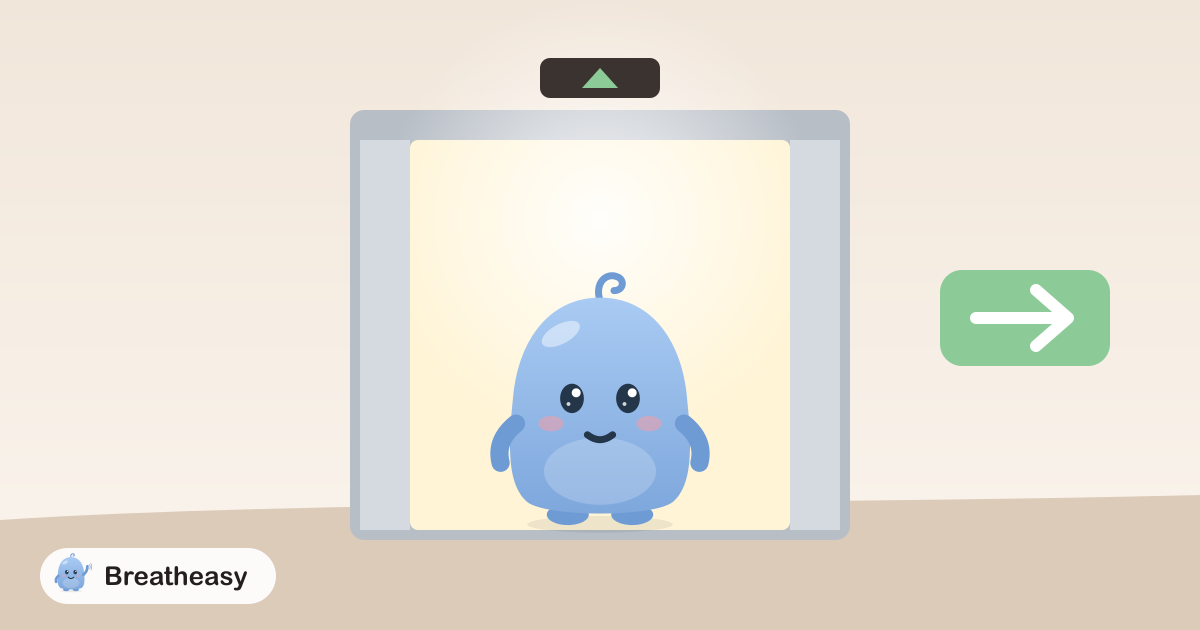
The lift doors close and your chest tightens. Your heart races, the walls seem to press in, and every part of you wants out. You might take the stairs for twelve floors rather than face it again.
That’s claustrophobia. It’s very common, and very treatable. Here’s what it is, how to cope in the moment and how to overcome it.
What is claustrophobia?
Claustrophobia is an intense fear of confined or enclosed spaces. It’s a type of specific phobia. The NHS estimates that around 10% of people in the UK are affected by claustrophobia at some point in their lives.
For some, it’s mild discomfort. For others, being in a tight space triggers severe anxiety or a panic attack. The fear is often less about the space itself and more about being trapped, unable to get out, or running out of air.
Common triggers
The NHS lists triggers including:
- lifts
- tunnels
- underground trains
- public toilets
- rooms where the doors have to be locked
- cars
- hotel rooms with sealed windows
- planes
Others include MRI scanners, crowded spaces, changing rooms, and tight clothing or masks. For some people, just thinking about these places can trigger anxiety.
Symptoms
Claustrophobia can cause panic attacks and physical symptoms such as sweating, trembling, a racing heart, shortness of breath or a choking feeling, chest tightness, dizziness, nausea, feeling faint and pins and needles. People often fear losing control, fainting or dying, or feel detached from their body.
What causes it?
The NHS says claustrophobia is often linked to a frightening experience, especially in early childhood, like being trapped or kept in a confined space, being bullied or abused, or growing up with a parent who had claustrophobia. Sometimes it follows a panic attack in a confined space. For some people, there’s no obvious cause.
In the moment
- Breathe out slowly. In through your nose for 4, out through your mouth for 6. Remind yourself there’s plenty of air.
- Name it. “This is claustrophobia. I feel trapped, but I’m safe, and the feeling will pass.”
- Focus outward. Count floors, read a sign, look at a fixed point or describe something in detail.
- Ground yourself. Press your feet into the floor and feel your hands on something solid.
- Remind yourself of time. A lift ride lasts a minute or two. Panic peaks within about 10 minutes and passes.
MRI scans
If you need an MRI scan and you’re claustrophobic:
- Tell the hospital before the day. Staff are used to helping nervous patients.
- Ask about options, like music, a mirror that lets you see out, keeping your eyes closed, or having someone in the room.
- Talk to your doctor in advance about whether a sedative is appropriate.
- Ask whether an open or upright MRI is possible, which some centres offer.
- Use slow breathing during the scan.
Treatment that works
The most effective treatment for specific phobias, including claustrophobia, is exposure therapy: facing the feared situation gradually, step by step, until the fear fades. A review of 33 trials found exposure-based treatments worked better than other approaches for specific phobias. It’s often delivered as part of cognitive behavioural therapy (CBT), and sometimes in very few sessions.
An example ladder:
- Look at pictures of lifts
- Stand in a lift with the doors open
- Ride one floor with someone
- Ride one floor alone
- Ride several floors
- Ride at a busy time
Our post on exposure therapy explains how it works.
When to get help
Talk to a doctor if claustrophobia is limiting your life, for example if you’re avoiding lifts, public transport, flights or medical scans you need. Specific phobias respond especially well to treatment.
Frequently asked questions
What does it mean to be claustrophobic?
It means having an intense fear of confined or enclosed spaces, like lifts, tunnels or small rooms. People often fear being trapped or not being able to breathe.
Can claustrophobia be cured?
Many people overcome claustrophobia completely with exposure-based therapy, often in a relatively small number of sessions.
Why is my claustrophobia getting worse?
Avoiding confined spaces brings relief, but it teaches your brain they’re dangerous, so the fear can grow and spread to more places. Gradual exposure reverses this.
Is claustrophobia a panic disorder?
No. Claustrophobia is a specific phobia, but it can cause panic attacks in confined spaces. If you have panic attacks in many different situations, a doctor may also look at panic disorder or agoraphobia.
How Breatheasy can help
Breatheasy can help you through confined spaces and each step of your ladder. Tap “I’m feeling anxious” and Luma walks you through it: rate how strong it feels, breathe slowly as your phone pulses gently, ground yourself with 5-4-3-2-1, then see how far the anxiety came down. It works without internet, so it helps in lifts, tunnels and planes too. Breatheasy is coming soon to iPhone and Android.
Sources
- Claustrophobia, NHS
- Psychological approaches in the treatment of specific phobias: a meta-analysis, Wolitzky-Taylor and others, Clinical Psychology Review, 2008
- Specific phobia statistics, National Institute of Mental Health
- Phobias, NHS