Breatheasy
Fear of heights (acrophobia): why it happens and how to overcome it
A fear of heights is one of the most common phobias. What acrophobia feels like, how it differs from vertigo, why it develops, tips for coping and the treatments that work, including virtual reality.
 Breatheasy team27 October 2026 · 4 min read
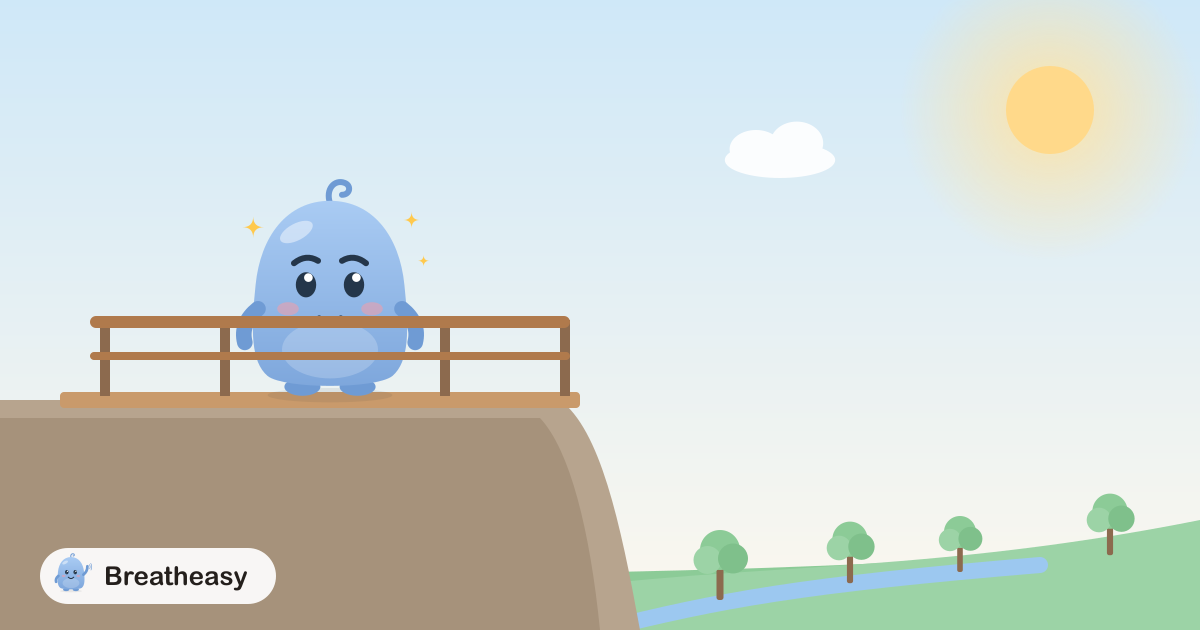
You reach the top of the stairs on a viewing platform and your legs turn to jelly. Your heart races, your palms sweat, and you’re sure you’re about to fall, or that something might make you jump. You back away from the edge as fast as you can.
A fear of heights is one of the most common fears there is. Here’s what it is, and how to overcome it.
What is acrophobia?
Everyone has some caution about heights. That’s healthy. Acrophobia is when the fear is intense, out of proportion to the actual danger, and leads you to avoid situations like:
- balconies, bridges and viewing platforms
- ladders and stepladders
- escalators, glass lifts and stairwells
- tall buildings, hills and mountains
- flying, for some people
What it feels like
- dizziness or feeling off-balance
- a racing heart and sweating
- trembling, weak legs
- an urge to crouch, grab hold of something or get down
- fear of falling, or an alarming urge to jump
- panic
That urge to jump, sometimes called the “call of the void”, is a common intrusive thought. It doesn’t mean you want to jump.
Fear of heights or vertigo?
People often use “vertigo” to mean fear of heights, but they’re different:
- Vertigo is a spinning or moving sensation, usually caused by an inner ear or balance problem, and can happen anywhere.
- Acrophobia is fear triggered by heights.
If you feel the room spinning, even when you’re not high up, see a doctor. Our post on whether anxiety can cause dizziness explains more.
Why it develops
- Evolution: caution around heights helped our ancestors survive.
- A frightening experience, like a fall or a scare at a height.
- Balance and vision: at height, there are fewer nearby visual cues, so your balance system relies more on your body, which can feel unsteady.
- Learning: seeing a parent afraid of heights.
- Avoidance, which keeps the fear going.
Coping in the moment
- Breathe out slowly. In for 4, out for 6.
- Look at something stable and nearby, rather than down or into the distance.
- Hold a rail and feel your feet firmly on the ground.
- Name it: “This is fear of heights. I’m safe, and the feeling will pass.”
- Stay a little longer before moving back, if it’s safe. Leaving at the peak of fear teaches your brain the height was dangerous.
Treatment that works
- Gradual exposure: facing heights step by step, from looking out of a first-floor window to a balcony to a higher viewpoint, until the fear fades.
- Virtual reality (VR): in a 2018 trial, 100 people with a fear of heights were randomly assigned to automated VR therapy or usual care. The VR group spent about two hours in treatment on average, and their fear of heights fell dramatically compared with the control group, with the benefit lasting at follow-up.
- CBT, to work with thoughts like “I’ll fall” or “I won’t cope”.
Our post on exposure therapy explains how it works.
When to get help
Talk to a doctor if fear of heights is limiting your life, like avoiding work, travel or time with family, or if you have dizziness or spinning that isn’t only at heights.
Frequently asked questions
Is fear of heights normal?
Some caution about heights is completely normal and helpful. It becomes a phobia when the fear is intense, out of proportion and leads to avoidance that affects your life.
Why do I feel like jumping when I’m high up?
It’s a common intrusive thought, sometimes called the “call of the void”. Many people experience it, and it doesn’t mean you want to jump.
Can you overcome a fear of heights?
Yes. Gradual exposure, including virtual reality therapy, helps most people, sometimes quickly.
What is the difference between acrophobia and vertigo?
Acrophobia is a fear of heights. Vertigo is a spinning sensation, usually caused by an inner ear or balance problem, which can happen anywhere.
How Breatheasy can help
Breatheasy can come with you on each step of facing heights. Tap “I’m feeling anxious” and Luma walks you through slow breathing and grounding, then shows how far your fear came down, evidence that you can cope. Breatheasy is coming soon to iPhone and Android.
Sources
- Automated psychological therapy using immersive virtual reality for treatment of fear of heights, Freeman and others, Lancet Psychiatry, 2018
- Psychological approaches in the treatment of specific phobias: a meta-analysis, Wolitzky-Taylor and others, Clinical Psychology Review, 2008
- Phobias, NHS
- Vertigo, NHS