Breatheasy
How to stop intrusive thoughts (and why fighting them backfires)
Almost everyone has disturbing thoughts that pop up out of nowhere. Why pushing them away makes them stick, and what helps them fade.
 Breatheasy team27 October 2026 · 6 min read
You’re holding a baby and suddenly picture dropping it. You’re standing on a platform and get an urge to jump. You’re in a place of worship and a blasphemous thought flashes up. Then comes the horror: Why would I think that? What does it say about me?
These are intrusive thoughts. They can be frightening, shameful and very hard to shake. The good news is that they’re extremely common, they don’t mean what they feel like they mean, and there’s a lot you can do to make them fade, though perhaps not in the way you’d expect.
What intrusive thoughts are
Intrusive thoughts are unwanted thoughts, images or urges that pop into your mind without warning. They often feel shocking, because they go against everything you value. Common themes include:
- Harm: hurting someone, often someone you love, or harming yourself.
- Sexual thoughts that feel wrong or out of character.
- Religious or moral thoughts: blasphemy, sin, or doing something wrong.
- Contamination: germs, illness or dirt.
- Doubt: “Did I lock the door? Did I hit someone while driving?”
- Embarrassment: shouting something inappropriate, or losing control in public.
- Relationships: “Do I really love my partner?”
Intrusive thoughts aren’t the same as the impulsive urges people joke about online. We explain the difference in Intrusive vs impulsive thoughts.
Almost everyone has them
A large international study, covering people on six continents, found that almost everyone had experienced unwanted intrusive thoughts. Most people notice them, think “that was weird”, and move on.
The difference with people who get stuck is not the thoughts themselves. It’s how they react to them.
Thoughts aren’t actions, wishes or warnings
When an intrusive thought shows up, it can feel like a message: a secret desire, a warning sign, or proof that you’re a bad person. It isn’t.
- A thought is not an action. Thinking about something doesn’t make it more likely to happen.
- A thought is not a wish. The fact that it horrifies you shows it goes against what you want.
- A thought is not a prediction. Your brain throws up all sorts of possibilities. Most are just noise.
People who are most upset by violent intrusive thoughts are often especially caring people, which is exactly why the thoughts clash so strongly with who they are.
Why fighting them backfires
The natural response to a horrible thought is to push it away. Unfortunately, that tends to make it come back more.
You may know the classic experiment: try not to think of a white bear for the next minute. Most people find the bear keeps popping up. A review of studies on thought suppression found that trying to suppress a thought tends to bring it back, with a small to moderate “rebound” effect.
The same goes for other ways of fighting the thought:
- Arguing with it or analysing what it means
- Seeking reassurance: asking others, or googling, whether it means something bad
- Checking: your feelings, your memory, your surroundings
- Avoiding people, places or objects that trigger it
- Neutralising it: replacing it with a “good” thought, praying, or counting
Each one brings a moment of relief, but teaches your brain the thought was dangerous and needed dealing with. So it sends the thought back, louder. Our post on why reassurance keeps OCD going explains this loop in more detail.
How to make intrusive thoughts fade
You can’t stop a thought from appearing by force. What you can change is what happens next. When the thought stops getting a big reaction, your brain learns it isn’t important, and it comes less often and with less punch.
1. Label it
Notice the thought and name it: “That’s an intrusive thought.” Or: “There’s my brain doing that thing again.” Labelling puts a little distance between you and the thought.
2. Let it be there
Instead of pushing it away, let it sit in your mind, like background noise. You might even say: “Maybe, maybe not,” or “Thanks, brain.” This feels uncomfortable at first. That discomfort is the old fear fading.
3. Don’t argue or analyse
Resist the urge to work out what the thought means or prove it wrong. You won’t find a final answer, and the search keeps the thought alive.
4. Carry on with what you were doing
Turn your attention back to your task, your conversation or your surroundings, and let the thought tag along if it wants. You don’t have to wait for it to leave before getting on with your day.
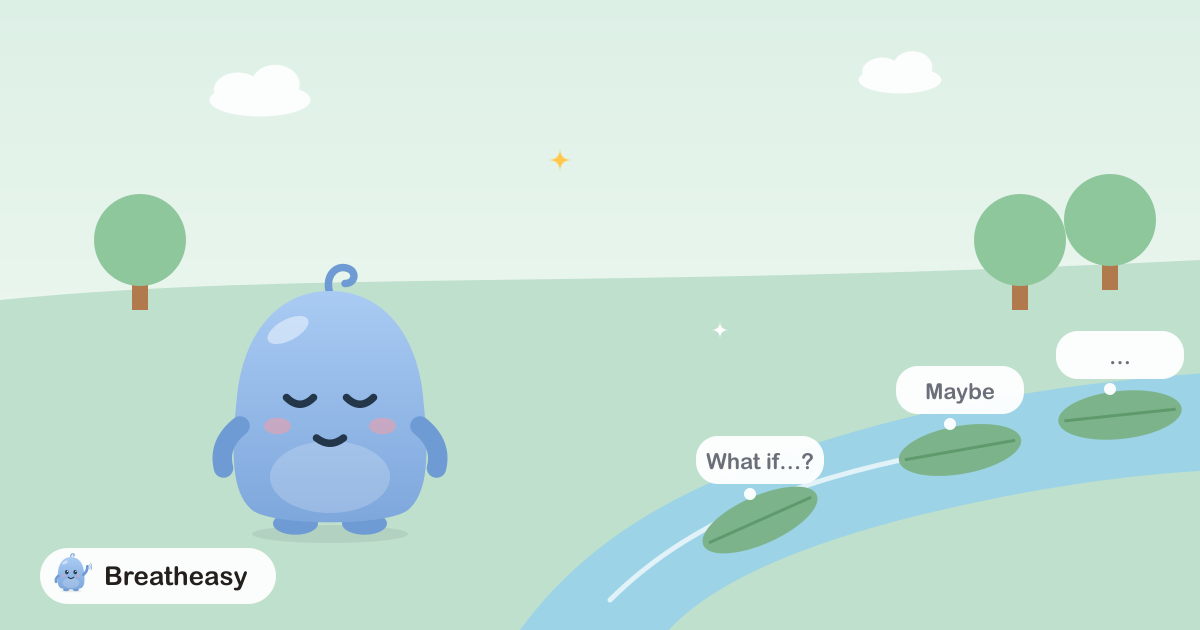
5. Picture leaves on a stream
A mindfulness exercise many people find helpful: imagine sitting by a stream, and place each thought on a leaf. Watch it float past. You don’t need to push the leaves along or hold them back.
6. Slowly stop avoiding
If you’ve been avoiding things because of the thoughts, like knives, holding a baby or certain places, start reintroducing them in small steps. Each time you do, your brain learns there was no danger.
7. Be patient
Changing your reaction takes practice. The thoughts usually don’t disappear overnight, but they lose their grip with time. Expect them to flare up when you’re tired or stressed. That’s normal, not a sign you’ve failed.
When it might be OCD
Intrusive thoughts are a normal part of being human. They may be part of obsessive-compulsive disorder (OCD) when:
- they take up a lot of your time, often more than an hour a day
- they cause a lot of distress or get in the way of your life
- you feel driven to do things to get rid of them or feel safe, like checking, washing, asking for reassurance, praying or mental reviewing
OCD is very treatable. The recommended treatment is cognitive behavioural therapy that includes exposure and response prevention (ERP), which helps you face the thoughts without doing the compulsions. Medicine, usually an SSRI antidepressant, can help too.
How Breatheasy can help
Breatheasy can help you practise letting thoughts be. Breatheasy’s “Ride out an urge” tool waits with you for 5, 10 or 15 minutes while the urge to check, search or ask for reassurance rises, peaks and falls, with gentle check-ins along the way. Over time, the thoughts lose their grip. Breatheasy is coming soon to iPhone and Android.
When to get help
Talk to a doctor or therapist if intrusive thoughts are taking up a lot of your time, causing you distress, or making you avoid things. A therapist who specialises in OCD has heard every kind of intrusive thought before, and won’t be shocked by yours.
Intrusive thoughts about harming yourself are common and don’t mean you want to. But if you have thoughts of ending your life that feel like something you want or plan to do, please reach out now: call or text 988 in the US, or call 911 if you’re in danger.
Sources
- Obsessive compulsive disorder (OCD), NHS
- Obsessive-compulsive disorder, National Institute of Mental Health
- Abramowitz, Tolin and Street (2001). Paradoxical effects of thought suppression: a meta-analysis of controlled studies. Clinical Psychology Review.
- Radomsky et al. (2014). You can run but you can’t hide: intrusive thoughts on six continents. Journal of Obsessive-Compulsive and Related Disorders.