Breatheasy
Intrusive vs impulsive thoughts: what’s the difference?
“My intrusive thoughts won” is all over social media, but it usually describes impulsive thoughts. Here’s the difference, and why it matters.
 Breatheasy team27 October 2026 · 5 min read
On social media, “my intrusive thoughts won” usually comes with a video of someone dyeing their hair blue, cutting their own bangs, or pushing a cake off the table. It’s funny, but it has left a lot of people confused, especially people who live with real intrusive thoughts and find them anything but fun.
Here’s the difference between intrusive and impulsive thoughts, and why it matters.
The short answer
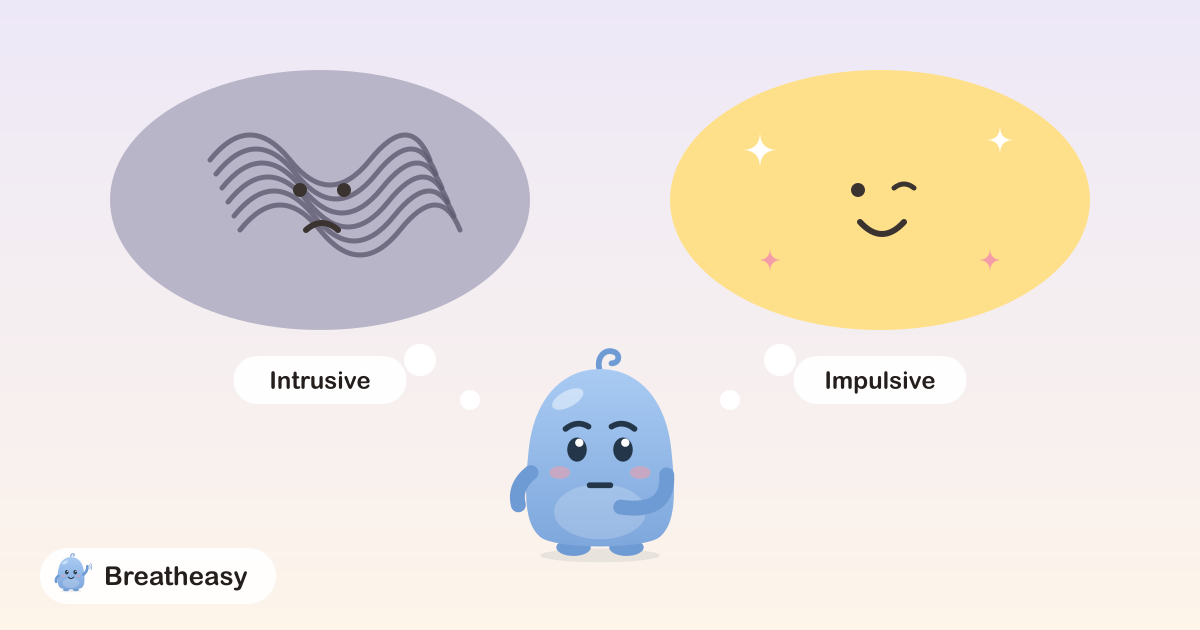
Intrusive thoughts are unwanted thoughts, images or urges that pop into your head and upset you, because they go against who you are and what you want. You don’t want to act on them, and the idea of acting on them is distressing.
Impulsive thoughts are sudden urges to do something you might actually be tempted to do, often something fun, silly, rash or risky. Part of you wants to do it, even if you know you probably shouldn’t.
Side by side
| Intrusive thought | Impulsive thought | |
|---|---|---|
| Do you want it? | No. It feels alien and upsetting | Partly. It’s tempting |
| How it feels | Distressing, shameful, frightening | Exciting, mischievous, “why not?” |
| Common examples | Harming someone you love, shouting something offensive, a blasphemous image | Quitting your job on the spot, buying something on a whim, a dramatic haircut |
| What people do | Try to push it away, check, avoid or seek reassurance | Sometimes act on it |
| Linked with | Anxiety and OCD | ADHD, excitement, boredom, stress |
What intrusive thoughts are like
Intrusive thoughts tend to be about the very things you care most about not doing. A loving parent pictures hurting their baby. A religious person has a blasphemous thought in prayer. A gentle person imagines shouting something cruel. The horror you feel is a sign that the thought goes against your values.
Almost everyone has intrusive thoughts. Most people shrug them off. For some, especially people with OCD, the thoughts become sticky, because they try hard to push them away, check what they mean, or seek reassurance. Our post on how to stop intrusive thoughts explains why that backfires, and what helps.
What impulsive thoughts are like
Impulsive thoughts are urges to do something now, without stopping to weigh it up: say exactly what you think, book a trip, eat the whole cake, text your ex. They often come with a little thrill.
Everyone has them. They can be stronger when you’re bored, tired, stressed, or have ADHD, which affects how easily you can put the brakes on an urge.
What about the urge to jump?
Many people have stood somewhere high, like a balcony, a cliff edge or a train platform, and felt a sudden, strange urge to jump. It’s sometimes called “the call of the void”.
In a 2012 study of 431 college students, this experience was common, even among people who had never had thoughts of suicide. The researchers suggested it may be a misread safety signal: your survival instinct tells you to step back from the edge, and your mind, noticing that jolt, wonders why. In other words, it’s more likely a sign of your will to live than a wish to die.
If you do have thoughts of ending your life, that’s different, and you deserve support. Call or text 988 in the US, or 911 if you’re in danger.
Why the difference matters
When intrusive thoughts get called impulsive, or the other way round, it can cause real harm:
- People with intrusive thoughts may fear they’ll act on them. Hearing “my intrusive thoughts won” can make someone with OCD panic that one day theirs will too. Intrusive thoughts are, by their nature, things you don’t want to do, and having them doesn’t make you more likely to act.
- People may feel ashamed. Intrusive thoughts often feel too awful to share. Knowing they’re common and meaningless helps people get support.
- The right help is different. Intrusive thoughts get stickier when you fight them, so help focuses on letting them be. Impulsivity is helped by building in a pause before acting.
What helps
For intrusive thoughts: label the thought (“that’s an intrusive thought”), let it be there without arguing, don’t check or seek reassurance, and carry on with your day. If they’re taking over your life, CBT with exposure and response prevention (ERP) is very effective for OCD.
For impulsive thoughts: build in a pause. Wait 10 minutes, or sleep on it, before acting on a big urge. If impulsivity is causing problems at work, with money or in relationships, it may be worth talking to a doctor about ADHD.
How Breatheasy can help
If intrusive thoughts leave you wanting to check or seek reassurance, Breatheasy can help. Breatheasy’s “Ride out an urge” tool waits with you for 5, 10 or 15 minutes while the urge to check, search or ask for reassurance rises, peaks and falls, with gentle check-ins along the way. Breatheasy is coming soon to iPhone and Android.
When to get help
Talk to a doctor or therapist if intrusive thoughts are taking up a lot of time, causing distress, or leading you to avoid things, or if impulsive urges are causing you real problems.
Sources
- Obsessive compulsive disorder (OCD), NHS
- Obsessive-compulsive disorder, National Institute of Mental Health
- Hames, Ribeiro, Smith and Joiner (2012). An urge to jump affirms the urge to live: an empirical examination of the high place phenomenon. Journal of Affective Disorders.