Breatheasy
Can you have a panic attack for no reason?
Yes, and it’s one of the most frightening things about panic. Why panic attacks can strike out of the blue, even in your sleep, and what helps.
 Breatheasy team27 October 2026 · 3 min read
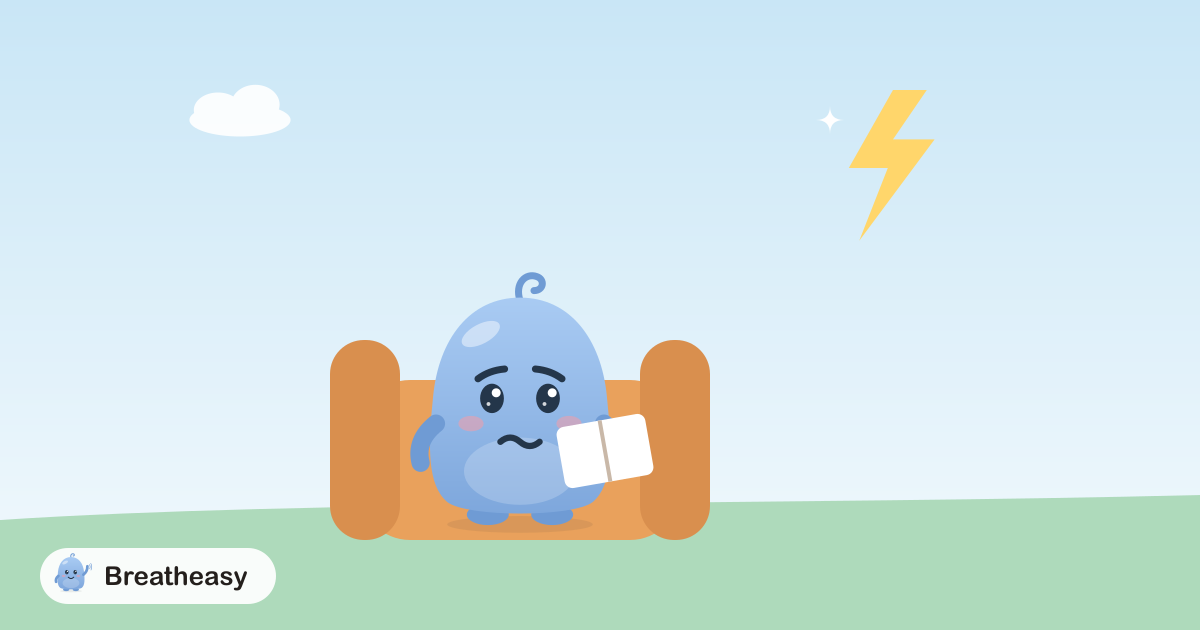
You’re watching TV, reading in bed or sitting quietly at work. Nothing is wrong. Then, out of nowhere, your heart is pounding and you’re terrified. Afterwards, the hardest question is: why?
Yes, you can have a panic attack for no obvious reason. It’s common, it has a name, and understanding it takes away a lot of its power.
Unexpected panic attacks are common
Doctors talk about two kinds of panic attacks:
- Expected panic attacks happen in situations you fear, like flying, crowds or public speaking.
- Unexpected panic attacks seem to come out of the blue, with no obvious trigger.
Unexpected attacks are so common that they’re part of how doctors define panic disorder: panic attacks that keep happening without warning, along with worry about having more.
There’s usually a trigger you didn’t notice
When panic seems to come from nowhere, there’s often a trigger you didn’t consciously register:
- A body sensation. A skipped heartbeat, a moment of dizziness after standing up, a yawn that didn’t feel satisfying or a twinge in your chest. Your brain, on the lookout for danger, notices it before you do and sounds the alarm.
- Stress catching up with you. Panic often strikes when you finally relax after a stressful stretch, because that’s when your body and mind turn inward.
- A passing thought or memory, gone before you noticed it.
- Tiredness, hunger or a hangover, which make your alarm system jumpier.
This is the panic loop at work: a small sensation is read as danger, fear releases adrenaline, adrenaline makes the sensation stronger, and within a minute or two it’s a full panic attack. We explain it in What causes panic attacks?
Panic attacks in your sleep
Some people wake suddenly in a panic, with a racing heart and a sense of dread, with no nightmare to explain it. These night-time panic attacks happen during deep sleep, and they’re not a sign of anything dangerous happening while you sleep. They’re a common part of panic disorder. Why is my anxiety worse at night? covers what helps.
When it might be something else
Some health conditions and substances can cause sudden panic-like symptoms, including:
- an overactive thyroid
- some heart rhythm problems
- low blood sugar
- caffeine, energy drinks or stimulants, including some cold medicines and ADHD medicines
- cannabis, or coming off alcohol
- stopping some medicines suddenly
That’s why it’s worth seeing a doctor after your first panic attack, or if your attacks change. A few simple checks can rule these out.
What helps
- Remind yourself that “no reason” doesn’t mean “dangerous”. The attack is still your body’s alarm, not a sign that something is wrong.
- Ride it out: slow your out-breath, ground yourself through your senses and let the wave pass.
- Don’t try to work out the cause mid-attack. You can reflect later.
- Don’t start avoiding everyday places just in case. That tends to make panic grow.
- Look after the basics: sleep, regular meals, and less caffeine and alcohol.
How Breatheasy can help
When panic strikes out of nowhere, Breatheasy is there in your pocket. Tap “I’m feeling anxious” and Luma walks you through it: rate how strong it feels, breathe slowly as your phone pulses gently, ground yourself with 5-4-3-2-1, then see how far the anxiety came down. Afterwards, ten-second check-ins and a journal can help you spot hidden patterns, like poor sleep or extra coffee before an attack. The panic button works without internet and is always free. Breatheasy is coming soon to iPhone and Android.
When to get help
See a doctor after your first panic attack, or if attacks keep happening. Panic disorder is very treatable, especially with cognitive behavioural therapy (CBT). Our guide to anxiety and panic attacks is a good place to start.
Call 911 if you have chest pain that spreads to your arm, jaw, neck or back, or you’re struggling to breathe.
Sources
- Panic disorder, NHS
- Panic Disorder: When Fear Overwhelms, National Institute of Mental Health
- Clark, D. M. (1986). A cognitive approach to panic. Behaviour Research and Therapy.