Breatheasy
What causes panic attacks?
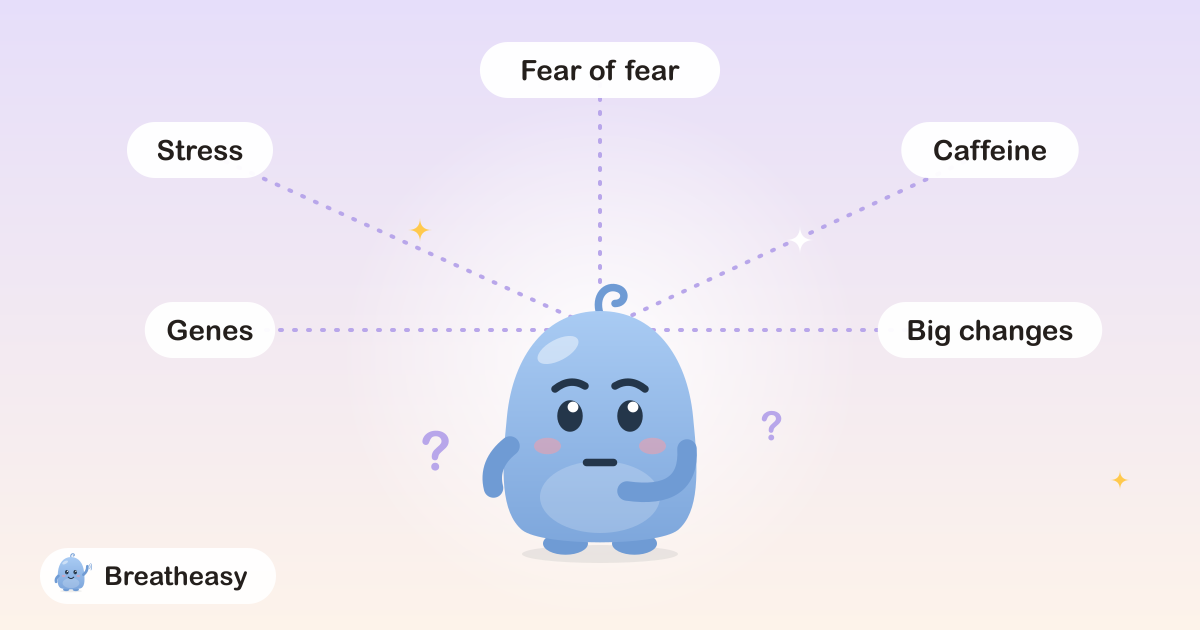
Genes, stress, your body and the fear of fear itself. Why panic attacks happen, why they can strike out of the blue, and what you can change.
 Breatheasy team27 October 2026 · 5 min read
After a panic attack, one question often comes up again and again: why did that happen? Not knowing can make the next attack feel even more frightening.
The good news is that a lot is known about what causes panic attacks. Understanding it takes away much of their power.
The short answer: a false alarm
Your body has an alarm system called the fight-or-flight response. When your brain senses danger, it releases adrenaline so you can fight or run. Your heart speeds up, you breathe faster and your muscles tense.
A panic attack is that alarm going off when there’s no danger to fight or run from. Everything you feel is real, and every feeling is your body getting ready for action. We explain each one in What’s happening in your body during a panic attack.
So the real question is: why does the alarm go off when it shouldn’t? The answer is usually a mix of things, rather than one cause.
What makes some people more likely to have panic attacks
Genes and family history
Panic disorder tends to run in families. If a parent, brother or sister has it, you’re more likely to have it too. Genes don’t decide your future, but they can make your alarm system more sensitive.
Temperament
Some people are naturally more cautious or easily startled, and have been since childhood. Others are especially tuned in to their body, and quick to notice a change in their heartbeat or breathing. Neither is a flaw, but both can make panic more likely.
Stress and big life changes
Panic attacks often begin during or after a stressful stretch: a loss, a breakup, a move, illness, a new baby, starting college, or problems at work or with money. Sometimes the first attack comes just as things calm down, when your body finally catches up.
Difficult experiences earlier in life, including trauma, can also raise the chance of panic later on.
The fear of fear
This is one of the most important ideas in understanding panic, and it’s where things can change the most.
In the 1980s, the psychologist David Clark described panic as a loop. It goes like this:
- You notice a body feeling: a skipped beat, a moment of dizziness, a tight chest.
- You read it as danger: “I’m having a heart attack” or “I’m going to faint.”
- That thought makes you frightened, which releases adrenaline.
- Adrenaline makes the feelings stronger.
- Stronger feelings seem to prove the danger, so the fear grows.
Within a minute or two, a small sensation has turned into a full panic attack. After a few attacks, many people start to fear the feelings themselves, and watch their body closely for the first sign. That close watching makes normal feelings stand out even more.
This is also why cognitive behavioural therapy (CBT) works so well for panic. It targets step 2, helping you learn, from experience, that the feelings aren’t dangerous.
Why panic attacks seem to come out of the blue
Panic attacks that strike while you’re relaxed, watching TV or asleep are some of the most confusing. Often there is a trigger, you just didn’t notice it consciously:
- a change in your heartbeat after standing up
- a slightly faster breath, or a yawn that didn’t feel satisfying
- a moment of dizziness when you were tired or hungry
- a sudden thought or memory
Your brain, primed to look out for danger, picks up on it before you do and sounds the alarm. Calm moments can also give your mind space to turn inward after a busy, stressful day.
Things that can set off a panic attack
These don’t usually cause panic on their own, but they can push a sensitive alarm over the edge:
- Caffeine. Coffee, energy drinks and pre-workout drinks can bring on a racing heart and shakiness that feel just like panic.
- Alcohol, especially the next day. As alcohol wears off, your body rebounds into a more anxious state.
- Cannabis. It can bring on panic, especially in high doses or for people new to it.
- Nicotine and stimulants, including some cold and flu medicines and medicines for ADHD.
- Stopping some medicines suddenly, including some antidepressants and sleeping pills. Never stop a medicine without talking to a doctor.
- Not enough sleep or food. Low sleep and low blood sugar both make your body jumpier.
- Breathing too fast. Overbreathing can cause dizziness and tingling, which can then set off the panic loop.
Health problems that can feel like panic
Some medical conditions cause symptoms that overlap with panic, including an overactive thyroid, some heart rhythm problems, asthma and low blood sugar. That’s why it’s worth seeing a doctor after your first panic attack, or if your symptoms change. A few simple checks can rule them out and bring a lot of peace of mind.
What you can change
You can’t change your genes or your past, but there’s a lot you can do about the rest:
- Learn how panic works. Knowing your body is giving a false alarm weakens the fear at step 2 of the loop.
- Stop fighting the feelings. Let them rise and fall. Each time you ride one out, your brain learns it was safe.
- Practise slow breathing when you’re calm, with a longer out-breath than in-breath. Our post on calm, box and 4-7-8 breathing shows how.
- Cut down on caffeine and alcohol, and look after your sleep.
- Gently face what you’ve been avoiding, one small step at a time.
- Get support. CBT helps most people with panic. A doctor or therapist can help you find it.
You can find more on getting through attacks and treatment in our guide to anxiety and panic attacks.
How Breatheasy can help
Breatheasy can help you understand your own panic. After each panic moment, you can note what set it off, like caffeine, work or a crowded place, and your journal starts to show patterns over time. Bite-size lessons explain the panic loop, and the panic button helps you through attacks as they happen. Breatheasy is coming soon to iPhone and Android.
Sources
- Clark, D. M. (1986). A cognitive approach to panic. Behaviour Research and Therapy.
- Panic disorder, NHS
- Panic Disorder: When Fear Overwhelms, National Institute of Mental Health
- Panic attacks and panic disorder, Cleveland Clinic