Breatheasy
Travel anxiety: how to plan, cope on the way and enjoy the trip
Why travel brings on anxiety, a step-by-step plan for before you go, what to do if panic hits on the journey, and how to make travelling easier over time.
 Breatheasy team27 October 2026 · 6 min read
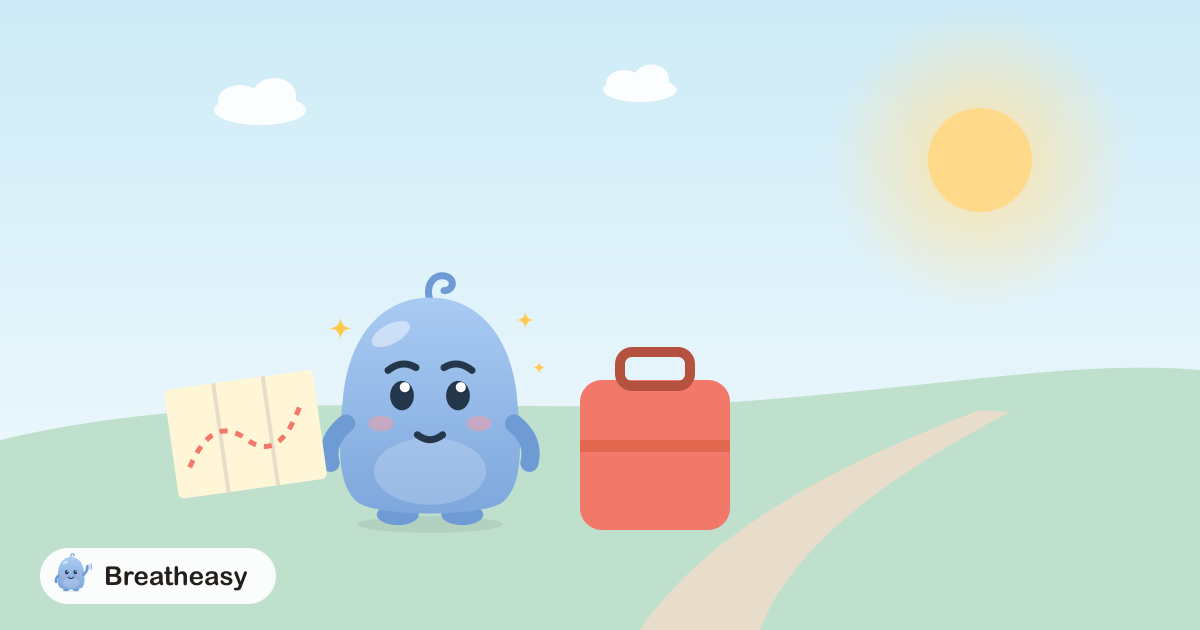
You’ve been looking forward to this trip for months. But as it gets closer, the worries start: What if I panic on the plane? What if I get lost? What if something goes wrong and I’m far from home?
Travel anxiety is very common, and it can affect anyone, from people who rarely feel anxious to people who live with panic attacks. Here’s how to prepare, cope on the way and enjoy being there.
Why travel brings on anxiety
- Uncertainty. New places, new routines and things you can’t predict.
- Loss of control. Delays, crowds, timetables and other people’s decisions.
- Being far from your safe places, like home, your own bed and your usual support.
- Feeling trapped. Planes, trains, long drives and boats are hard to leave mid-journey.
- Fear of panicking in public, or of being ill away from home.
- Past bad experiences, like a panic attack on a previous trip.
- Disrupted sleep, food and routine, which make everyone more anxious.
What it can feel like
- dread in the days or weeks before a trip
- trouble sleeping the night before
- a churning stomach or nausea
- checking tickets, passports and bags again and again
- feeling tense, irritable or tearful
- panic attacks before or during the journey
- wanting to cancel
Before you go
- Plan the journey in detail. Know your route, timings and connections. Uncertainty feeds anxiety; a plan shrinks it.
- Build in buffer time. Rushing makes everyone anxious. Arrive early, and allow for delays.
- Know your exits and breaks. Where can you stop on a drive? Where are the quiet spots at the airport? Knowing you can take a break often means you don’t need to.
- Pack the night before, with a short checklist. Check it once, then put it away.
- Pack a small calm kit: water, a snack, headphones, something to hold, and a card with your coping steps. Our post on making an anxiety coping kit explains how.
- Download what you need, like maps, tickets, music and calming apps, so they work without signal.
- Talk to your doctor before you go if you take regular medicine, have a health condition, or are thinking about medicine for the journey. Pack prescriptions in your hand luggage.
- Practise slow breathing in the days before, so it comes naturally when you need it.
On the journey
- Breathe out slowly. In for 4, out for 6. You can do it in a queue, a seat or a car without anyone noticing.
- Ground yourself. Notice 5 things you can see, 4 you can feel, 3 you can hear.
- Keep your body steady: drink water, eat regularly and go easy on caffeine and alcohol.
- Stay in the present. Focus on the next step of the journey, not the whole trip.
- Keep your mind busy with music, a podcast, a game or a conversation.
- Tell someone. Let a travel companion know what helps you. On a plane, train or bus, staff are used to helping nervous travellers.
If you have a panic attack while travelling
Remind yourself: “This is a panic attack. It feels awful, but it will peak and pass, here just like at home.” Then:
- Breathe out slowly, longer than you breathe in.
- Press your feet into the floor and feel your seat holding you.
- Name a few things around you.
- Sip cold water, or hold something cold.
- Let the wave rise and fall without fighting it.
If you’re driving, keep your eyes on the road, breathe slowly and pull over when it’s safe. Our posts on panic attacks while driving, panic attacks on a plane and turbulence anxiety have plans for each.
Get medical help if you have chest pain that spreads to your arm, jaw, neck or back, severe trouble breathing, or you faint. On a plane, press the call button and tell the crew it might be medical.
When you arrive
- Give yourself time to settle. The first day can feel unsettling. Unpack, find somewhere to eat and get your bearings.
- Keep some routine, like regular meals, a walk and a similar bedtime.
- Plan a gentle first day before anything ambitious.
- Know where to get help, like the nearest pharmacy or clinic and the local emergency number.
Making travel easier over time
Avoiding travel brings relief, but it tends to make the fear bigger. The most effective approach is to build confidence gradually, in steps:
- A short trip somewhere familiar, with someone you trust
- A day trip somewhere new
- A night away, not too far from home
- A longer journey, or a new kind of transport
- Further, or on your own
Repeat each step until it feels easier before moving on. This is called exposure, and it’s a core part of cognitive behavioural therapy (CBT). A CBT therapist can help, especially if travel anxiety comes with panic attacks or you’re avoiding more and more places, which can be a sign of agoraphobia.
Frequently asked questions
Why do I get anxious before travelling?
Travel combines lots of things anxiety dislikes: uncertainty, being out of control, being far from home and feeling stuck on a journey. Anxiety in the days before a trip is often worse than the trip itself.
How can I calm travel anxiety fast?
Slow your out-breath (in for 4, out for 6), press your feet into the floor and name a few things you can see. Our post on how to calm anxiety fast has more quick steps.
Should I take medicine for travel anxiety?
Talk to your doctor. Some people are prescribed medicine for flights or journeys, but sedatives can make you drowsy, shouldn’t be mixed with alcohol, and may make it harder for the fear to fade long term. CBT is the most effective long-term treatment.
Is travel anxiety a sign of something else?
Sometimes. It can be part of panic disorder, agoraphobia, a specific phobia (like a fear of flying) or generalised anxiety. If it’s stopping you from going places, talk to a doctor.
How Breatheasy can help
Breatheasy works without internet, so it travels with you. If anxiety spikes at the airport, on a train or as a passenger, tap “I’m feeling anxious” and Luma walks you through it: rate how strong it feels, breathe slowly as your phone pulses gently, ground yourself with 5-4-3-2-1, then see how far the anxiety came down. Never use your phone while driving. Breatheasy is coming soon to iPhone and Android.
Sources
- Agoraphobia, NHS
- Panic disorder, NHS
- Phobias, NHS
- Cognitive behavioural therapy (CBT), NHS
- Acute and delayed effects of alprazolam on flight phobics during exposure, Wilhelm and Roth, Behaviour Research and Therapy, 1997