Breatheasy
Breathing exercises for panic attacks
Six breathing exercises that calm a panic attack, which one to use when, and the common mistake that makes breathlessness worse.
 Breatheasy team27 October 2026 · 6 min read
When panic hits, your breathing speeds up and moves high into your chest. It can feel like you can’t get enough air, which makes the panic worse. Slowing your breathing down is one of the quickest ways to break that loop, because it’s one of the few parts of the panic response you can control directly.
Here are six breathing exercises for panic attacks, when to use each one, and the mistake to avoid.
Why breathing helps
During a panic attack, your body’s fight-or-flight system is in charge. Breathing slowly, and especially breathing out slowly, switches on the opposite system: the one that rests and calms you. Your heart rate dips slightly on every out-breath, so a long out-breath gives your body more of that slowing.
Slow breathing also stops you overbreathing. Breathing too fast lowers the carbon dioxide in your blood, which causes dizziness, tingling and a tight chest. Those feelings then seem to confirm the danger, and the panic grows.
A review of studies on slow breathing found it linked to more calm and relaxation, and less anxiety and anger.
How to breathe during a panic attack
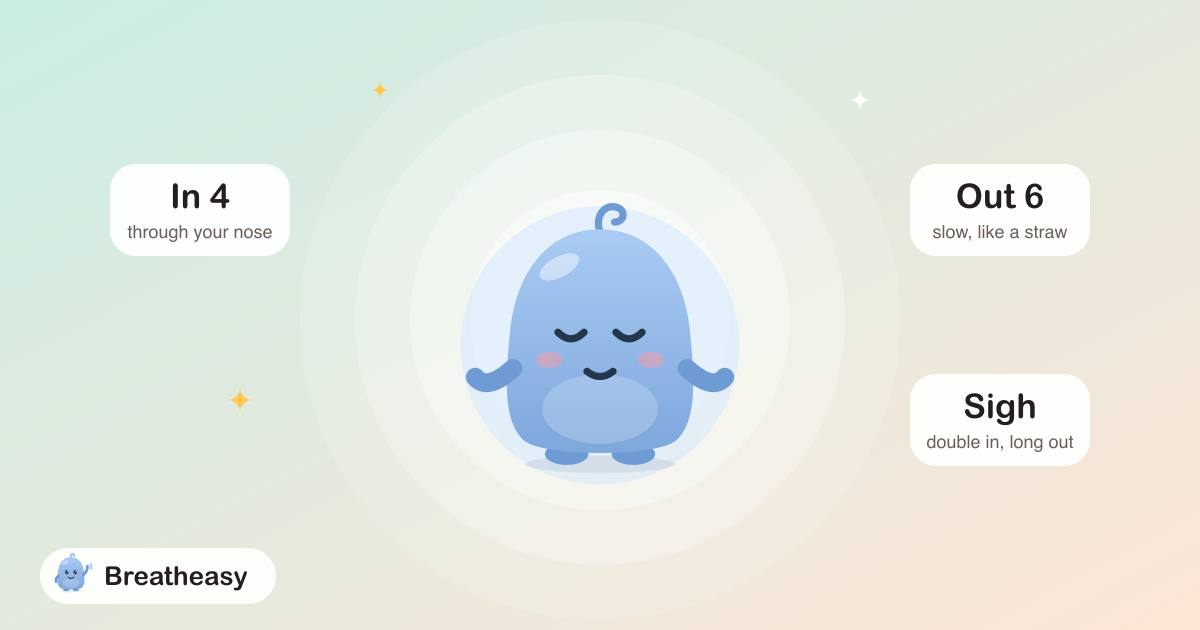
In short: slowly, gently and with a long out-breath. Breathe in softly through your nose for about 4, and out slowly through your mouth for about 6. Keep your breaths a normal size, and let your belly, not your shoulders, do the moving. The exercises below are all variations on this.
The mistake that makes it worse
When you feel short of breath, the instinct is to take big, deep gulps of air. That usually makes things worse, because it adds to the overbreathing.
Instead, breathe gently and slowly, through your nose if you can, and focus on making the out-breath longer than the in-breath. You’re already getting enough air. The goal is to slow down, not to get more in.
Deep breathing exercises for panic attacks: do they help?
“Deep breathing” is the most common advice for panic, but it’s often misunderstood. Taking big, deep gulps of air usually makes panic worse. What helps is breathing deeper in your body, low into your belly, while keeping each breath gentle and slow. If deep breathing has made you feel worse before, read why deep breathing can make anxiety worse.
1. Long out-breath: in for 4, out for 6
The simplest exercise, and the best place to start.
- Breathe in gently through your nose for a count of 4.
- Breathe out slowly through your mouth for a count of 6, as if blowing through a straw.
- Repeat for 2 to 5 minutes.
If 4 and 6 feel too long, try in for 3 and out for 5. What matters is that the out-breath is longer.
Use it: during a panic attack, anywhere. Nobody can tell you’re doing it.
2. Cyclic sighing
Also called the “physiological sigh”. It copies the double breath your body takes naturally when you sigh or after crying.
- Breathe in through your nose until your lungs feel full.
- Take a second, shorter sip of air through your nose on top.
- Breathe out slowly and fully through your mouth.
- Repeat for a few minutes.
In a 2023 study from Stanford University, people who did five minutes of cyclic sighing a day for a month had bigger improvements in mood than people who did mindfulness meditation, and their breathing rate slowed more too.
Use it: in the moment, or as a five-minute daily practice.
3. Belly breathing
Panic pulls your breath up into your chest. Belly breathing brings it back down to your diaphragm, the big muscle under your lungs.
- Sit or lie down, with one hand on your chest and one on your belly.
- Breathe in slowly through your nose, letting your belly rise. The hand on your chest should hardly move.
- Breathe out slowly, feeling your belly fall.
Use it: when you have a few minutes to sit down, and as daily practice.
4. Box breathing
Breathe in for 4, hold for 4, out for 4, hold for 4. Picture tracing the sides of a square.
The even rhythm gives your mind something to focus on, which many people find steadying. Some find the holds hard in the middle of a panic attack. If so, drop the holds and come back to the long out-breath.
Use it: before something stressful, like a meeting or a drive, or when anxiety is building.
5. 4-7-8 breathing
Breathe in for 4, hold for 7, then out for 8. The very long out-breath is deeply calming, but the hold can feel like too much when you’re already short of breath.
Use it: to wind down, especially at bedtime, rather than at the peak of a panic attack.
Our post on calm, box and 4-7-8 breathing compares these three in more detail.
6. Counting breaths
If counting seconds feels like too much, simply count your out-breaths from 1 to 10, then start again. If you lose count, that’s fine. Go back to 1.
Use it: when your mind is racing and you need something to hold on to.
Which one should I use?
| When | Try |
|---|---|
| In the middle of a panic attack | Long out-breath, or cyclic sighing |
| When anxiety is building | Box breathing, or long out-breath |
| Daily practice | Cyclic sighing or belly breathing, 5 minutes |
| At bedtime | 4-7-8, or belly breathing lying down |
| When your mind is racing | Counting breaths |
If focusing on your breath makes things worse
For some people, paying close attention to breathing during panic makes them more aware of every breath, and more anxious. If that’s you, switch to grounding: name 5 things you can see, 4 you can touch, 3 you can hear, 2 you can smell and 1 you can taste. You can come back to breathing once things settle.
Breathing into a paper bag is no longer recommended. It can be risky if your breathlessness turns out to have another cause, like asthma or a heart problem.
Practise when you’re calm
Breathing exercises work best when they’re familiar. A few minutes a day, when you’re not anxious, teaches your body the rhythm, so it’s there when panic hits. Many people pair it with something daily, like brushing their teeth or the first coffee of the day.
How Breatheasy can help
Want to be guided? Breatheasy’s breathing exercises (Calm, Box and 4-7-8, for 1, 3 or 5 minutes) pulse your phone as you breathe in, so you can follow along with your eyes closed. The panic button uses the same long out-breath to walk you through a panic attack, step by step. Both are always free. Breatheasy is coming soon to iPhone and Android.
When to get help
If you’re short of breath and it’s new, different or severe, get checked by a doctor. Call 911 if you have chest pain that spreads to your arm, jaw, neck or back, blue or grey lips, or you can’t get words out. How to tell if shortness of breath is from anxiety goes through the signs.
If panic attacks keep coming back, cognitive behavioural therapy (CBT) helps most people. Our guide to anxiety and panic attacks explains what it involves.
Sources
- Balban et al. (2023). Brief structured respiration practices enhance mood and reduce physiological arousal. Cell Reports Medicine.
- Zaccaro et al. (2018). How breath-control can change your life: a systematic review on psycho-physiological correlates of slow breathing. Frontiers in Human Neuroscience.
- Breathing exercises for stress, NHS
- Panic disorder, NHS