Breatheasy
How to tell if shortness of breath is from anxiety
Why anxiety makes it feel like you can’t breathe, the signs it’s likely anxiety, the signs that need a doctor straight away, and what helps.
 Breatheasy team27 October 2026 · 8 min read
Few feelings are as frightening as not being able to catch your breath. When it happens, it’s natural to worry that something is wrong with your heart or lungs, and that worry can make the breathlessness even worse.
Anxiety is one of the most common reasons people feel short of breath. Here’s why it happens, how to tell if anxiety is the likely cause, and when to get help straight away.
If you’re struggling to breathe right now, and especially if you have chest pain, blue or grey lips, or you can’t get words out, call 911 (or your local emergency number) now.
Can anxiety cause shortness of breath?
Yes. Shortness of breath is one of the most common symptoms of anxiety and panic. When you feel anxious, your body’s fight-or-flight response gets you ready to move. Your breathing changes in a few ways:
- You breathe faster and higher in your chest, using your shoulders and neck instead of your diaphragm, the big muscle under your lungs.
- You overbreathe. Breathing faster than your body needs lowers the carbon dioxide in your blood. That can cause dizziness, tingling in your fingers or around your mouth, and a tight chest.
- Your chest muscles tense up, which can make each breath feel restricted.
- You start to notice every breath. Breathing usually happens on autopilot. Watching it closely can make it feel effortful and strange.
The result is often a feeling called air hunger: the sense that you can’t get a satisfying breath, however hard you try. Ironically, it usually happens when you’re taking in more air than you need, not less. Many people respond by gulping or sighing deeply, which can make it worse.
Signs your shortness of breath is likely from anxiety
No list can diagnose you, but anxious breathlessness often has some of these features:
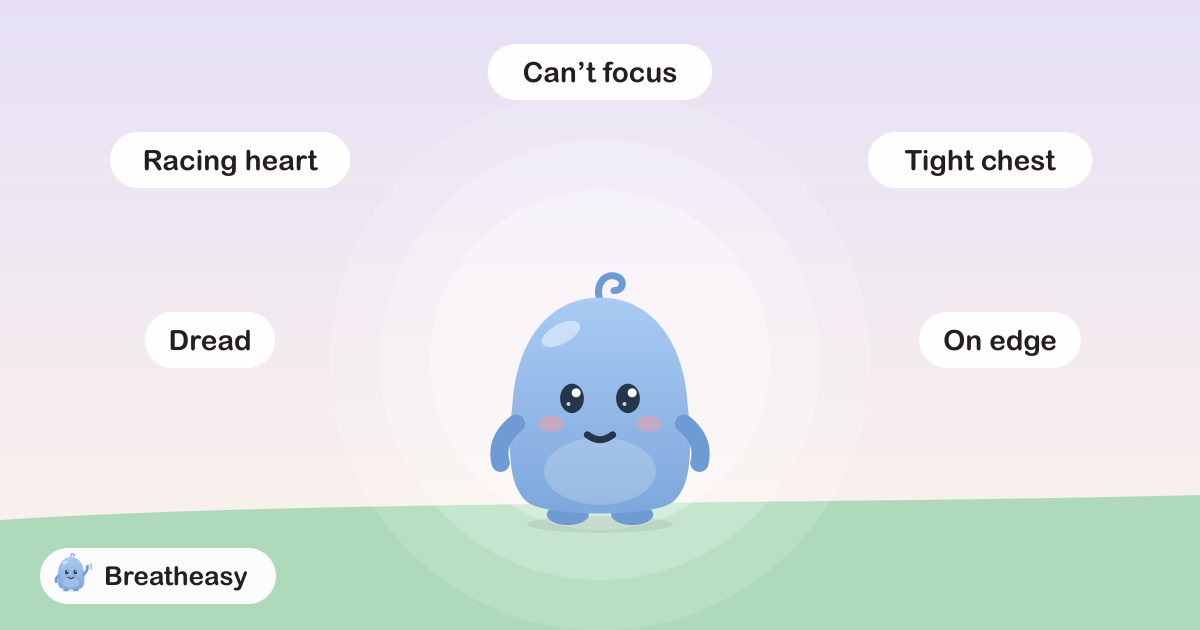
- It comes with other anxiety symptoms, like a racing heart, shaking, sweating, tingling, a sense of dread or feeling on edge.
- It happens at rest, or during stress, and not just when you’re exercising. Some people find it eases when they get moving.
- It feels like you can’t take a full breath, rather than wheezing or struggling to get air in or out.
- You keep sighing or yawning to try to get a deeper breath.
- It comes and goes, often with your mood, and you can still talk in full sentences.
- It eases when you’re distracted, or when you slow your breathing down.
- You’ve been checked before and nothing physical was found.
If you have a pulse oximeter, the small clip that goes on your finger, a normal reading during anxious breathlessness can be reassuring. It doesn’t rule out every problem, though, so new symptoms should still be checked.
Anxiety or something else? A quick comparison
These are patterns, not a test. Anxiety and a physical problem can happen together, so if you’re unsure, get checked.
| More typical of anxiety | More typical of a physical cause | |
|---|---|---|
| When it happens | At rest, or during stress or worry | When you exert yourself, when you lie flat, or waking you up gasping |
| What it feels like | You can’t get a satisfying breath, and want to sigh or yawn | Wheezing, noisy breathing, or struggling to get air in or out |
| Talking | You can still talk in full sentences | It’s hard to finish a sentence |
| What comes with it | Racing heart, tingling, shaking, dread | Fever, a cough, chest pain that spreads, swollen legs, blue or grey lips |
| What helps | Slowing your breathing, or getting distracted | Slow breathing and distraction don’t make much difference |
| Oxygen reading | Usually normal | May be low |
Signs it could be something else
Shortness of breath has many causes, including asthma, chest infections, heart problems and blood clots. Anxiety and a physical problem can also happen at the same time.
Call 911 (or your local emergency number) straight away if you have:
- severe difficulty breathing: gasping, choking or not able to get words out
- a chest that feels tight or heavy
- pain that spreads to your arms, back, neck or jaw
- lips or skin turning very pale, blue or grey
- sudden confusion
Get medical advice urgently, the same day, if you have:
- difficulty breathing that’s worse than usual for you
- breathlessness with a cough that brings up blood
- pain or swelling in one of your legs, especially after a long flight or drive, surgery or during pregnancy
- breathlessness with heart palpitations
- breathlessness with fever, chills or a bad cough
See a doctor soon if:
- you get more out of breath than usual with everyday activities, or when you lie down
- you’re short of breath and have swollen ankles
- you’ve had a cough for 3 weeks or more
- it’s the first time this has happened to you
If you’re ever unsure, get checked. Doctors would much rather see you and find it was anxiety than have you wait at home with something serious.
What a doctor might check
A doctor will usually ask about your symptoms, listen to your chest and check your pulse, blood pressure and oxygen level. Depending on what they find, they might suggest a heart tracing (ECG), a chest X-ray, a breathing test or blood tests. Normal results can bring real peace of mind, and they make it easier to trust that next time, it’s anxiety.
What helps anxious breathlessness
When you’ve been checked and you know anxiety is the cause, these help:
- Breathe out for longer than you breathe in. In through your nose for 4, out through your mouth for 6. The long out-breath presses your body’s brake pedal.
- Breathe low and slow. Put one hand on your chest and one on your belly. Let the belly hand rise as you breathe in, while the chest hand stays fairly still.
- Don’t gulp. Big gasps of air feed overbreathing. Small, slow breaths through your nose are better.
- Relax your shoulders. Let them drop away from your ears, and unclench your jaw.
- Sit upright or lean forward slightly with your forearms on your knees, which gives your diaphragm more room.
- Name it. “This is anxiety. I’m getting enough air. It will pass.”
Our post on calm, box and 4-7-8 breathing explains which rhythm helps most, and when.
Shortness of breath at night
Anxious breathlessness often shows up at night, when there’s nothing to distract you. You may wake suddenly feeling like you can’t breathe, sometimes in a panic. Slow, low breathing helps here too. But if you often get breathless lying flat, or wake up gasping, see a doctor, because this can also have physical causes.
When it keeps happening
If anxious breathlessness keeps coming back, you don’t have to put up with it. Cognitive behavioural therapy (CBT) can help with the anxiety behind it, and some people are offered breathing retraining with a physical or respiratory therapist to break the habit of overbreathing.
If breathlessness comes with sudden waves of fear, you may be having panic attacks. Our guide to anxiety and panic attacks and the full list of panic attack symptoms are good places to start.
Frequently asked questions
Can anxiety cause shortness of breath all day?
Yes. If you’re anxious for long stretches, you can slip into a habit of breathing fast and high in your chest, which keeps the breathless feeling going on and off all day. It’s still worth seeing a doctor, at least the first time, to rule out other causes.
Why do I feel like I can’t take a deep breath?
That feeling is called air hunger, and it’s very common with anxiety. Overbreathing and tense chest muscles make each breath feel unsatisfying, even though you’re getting plenty of air. Trying to force a big breath usually makes it worse. Slow, gentle breaths with a long out-breath help more. Our post on the fear of not being able to breathe explains more.
Can anxiety lower your oxygen levels?
Anxiety usually doesn’t. Breathing fast tends to keep your oxygen level normal. If a pulse oximeter shows a low reading, get medical advice. Bear in mind that these devices can be less accurate on darker skin, cold fingers or nails with polish, so how you feel matters more than any single number.
How long does shortness of breath from anxiety last?
During a panic attack, it usually eases within minutes as the panic passes. With ongoing anxiety, it can come and go over hours or days. Breathlessness that doesn’t ease, or keeps getting worse, needs a doctor.
How Breatheasy can help
Once a doctor has ruled out other causes, Breatheasy can help you slow your breathing when anxious breathlessness hits. Breatheasy’s breathing exercises (Calm, Box and 4-7-8, for 1, 3 or 5 minutes) pulse your phone as you breathe in, so you can follow along with your eyes closed. The Calm rhythm, in for 4 and out for 6, is built around the long out-breath that eases air hunger. Breatheasy is coming soon to iPhone and Android.
Sources
- Shortness of breath, NHS
- Breathing exercises for stress, NHS
- Panic disorder, NHS
- Panic attacks and panic disorder, Cleveland Clinic