Breatheasy
Calm down and breathe: a 60-second exercise
Feeling stressed, anxious or overwhelmed right now? A simple one-minute breathing exercise to help you calm down, with no equipment and no experience needed.
 Breatheasy team27 October 2026 · 3 min read
If you’re feeling stressed, anxious, angry or overwhelmed right now, try this. It takes one minute, you can do it anywhere, and nobody needs to know.
The 60-second exercise
- Get comfortable. Sit or stand, and let your shoulders drop. If you can, rest one hand on your belly.
- Breathe out first. Let out a slow breath through your mouth, emptying your lungs gently.
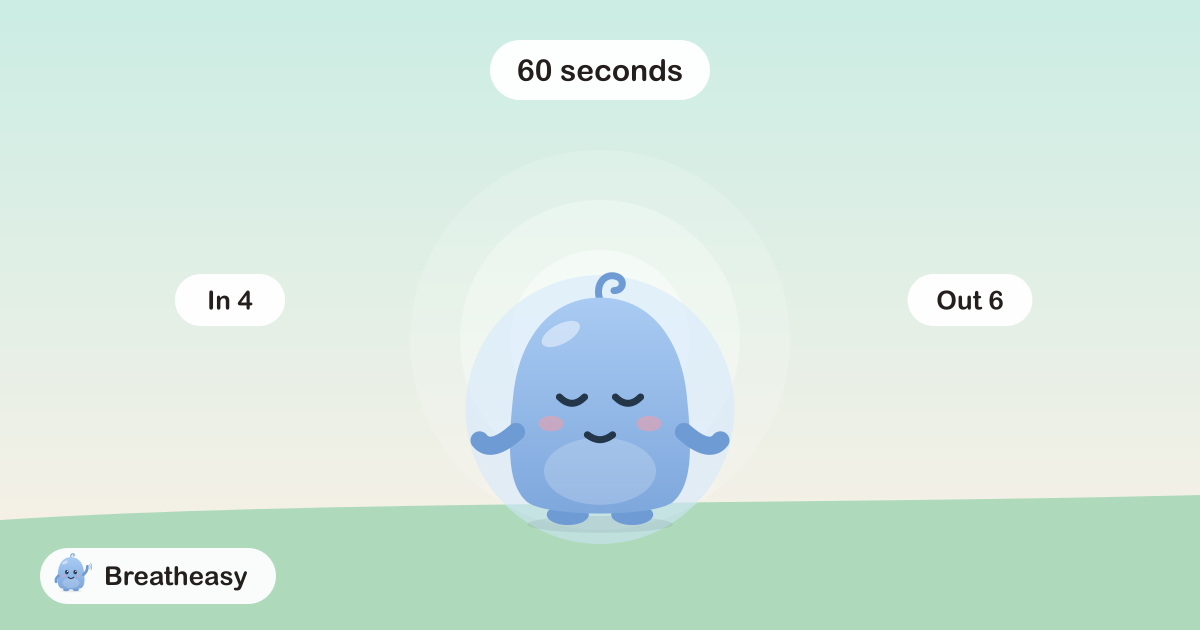
- Breathe in through your nose for a count of 4. A normal-sized breath, not a big gulp. Let your belly rise.
- Breathe out slowly through your mouth for a count of 6, as if blowing through a straw or cooling a hot drink.
- Repeat six times. That’s about one minute.
When you’re done, notice how you feel. You don’t need to feel completely calm, just a little steadier.
Why it works
When you’re stressed, your body’s fight-or-flight response speeds up your breathing and heart rate. Breathing out slowly does the opposite: it activates the calming side of your nervous system, and your heart rate dips a little each time you breathe out. A longer out-breath than in-breath gives your body more of that calming effect.
Counting also gives your mind something simple to focus on, instead of whatever is stressing you.
Tips to make it work
- Breathe gently. Big, deep breaths can leave you dizzy. If that happens, make your breaths smaller and slower. Our post on why deep breathing makes anxiety worse explains why.
- Adjust the count. If 4 and 6 feel too long, try 3 and 5. The out-breath just needs to be longer.
- Close your eyes if you’re somewhere you feel safe to.
- Practise when you’re calm. A minute a day, like before your morning coffee or at bedtime, makes it come naturally when you need it.
- Do it early. It works best when you catch stress or anxiety as it starts to rise.
Want more?
If one minute isn’t enough, keep going for 3 to 5 minutes. For more techniques, see our breathing exercises for panic attacks and breathing exercises for emotional regulation.
How Breatheasy can help
Breatheasy guides you through exactly this kind of breathing, so you don’t have to count. Choose Calm, Box or 4-7-8 breathing for 1, 3 or 5 minutes, and your phone pulses as you breathe in, so you can close your eyes and follow along. If stress tips into panic, tap “I’m feeling anxious” and Luma walks you through it, step by step. The breathing exercises are always free. Breatheasy is coming soon to iPhone and Android.
When to get help
If you feel stressed or anxious most days, or panic attacks keep happening, talk to a doctor. Breathing helps, but it’s one tool among many, and cognitive behavioural therapy (CBT) helps most people with anxiety. Our guide to anxiety and panic attacks is a good place to start.
If you’re struggling to breathe or have chest pain, call 911.
Sources
- Breathing exercises for stress, NHS
- Russo, Santarelli and O’Rourke (2017). The physiological effects of slow breathing in the healthy human. Breathe.
- Zaccaro et al. (2018). How breath-control can change your life: a systematic review on psycho-physiological correlates of slow breathing. Frontiers in Human Neuroscience.