Breatheasy
Depersonalization vs derealization: what’s the difference?
One makes you feel unreal, the other makes the world feel unreal. How to tell depersonalization from derealization, and why it doesn’t change what helps.
 Breatheasy team27 October 2026 · 4 min read
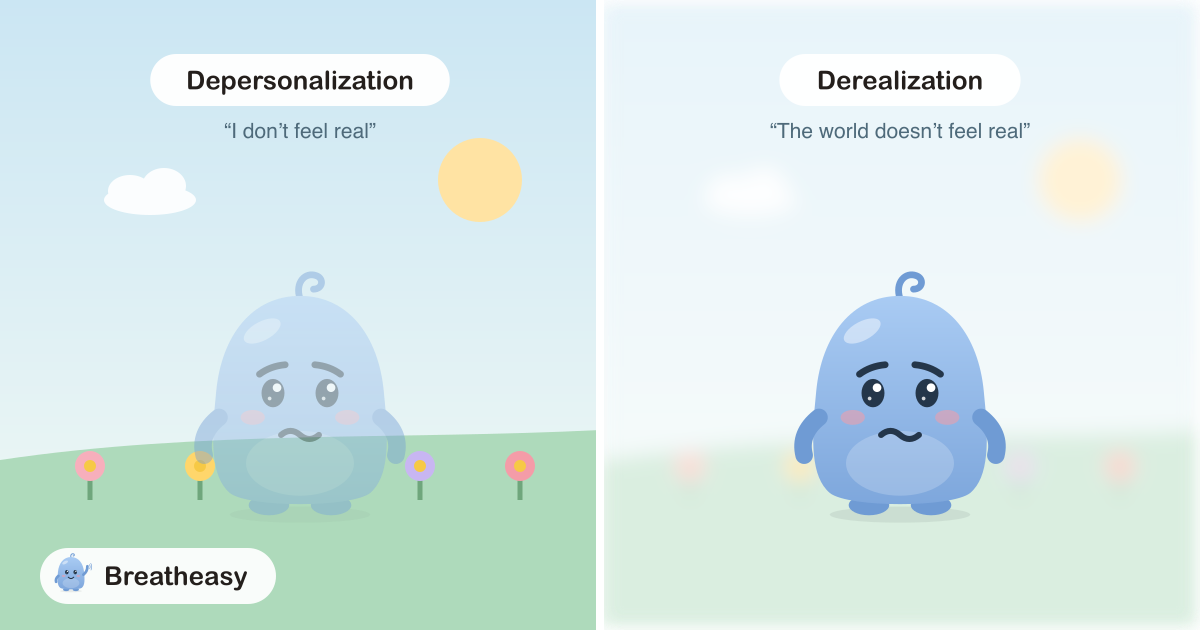
“I don’t feel like me.” “Nothing around me feels real.” These two experiences sound similar, and they often show up together, but they’re slightly different. One is about you, the other is about the world.
Here’s how to tell depersonalization from derealization, and why, in the end, the same things help both.
The short answer
Depersonalization is feeling detached from yourself: your body, your thoughts, your feelings or your actions. It can feel like watching yourself from outside, or like being on autopilot.
Derealization is feeling detached from the world around you. Places, objects and people can seem unreal, foggy, flat or dreamlike.
Many people have both. Doctors group them together as one condition, depersonalization-derealization disorder, when the feelings keep coming back or won’t go away and cause distress. You can read about the condition in Depersonalization-derealization disorder, explained.
Side by side
| Depersonalization | Derealization | |
|---|---|---|
| What feels unreal | You | The world around you |
| Common words | “I’m watching myself”, “I’m a robot”, “my hands aren’t mine” | “It’s like a dream”, “everything’s behind glass”, “it looks fake” |
| Body | Feeling numb, floaty, weightless or cut off from your body | Objects looking flat, too far, too close, or the wrong size |
| Emotions | Feeling emotionally blunted, even towards people you love | Familiar places and people feeling strange or distant |
| Senses | Your own voice sounding odd | Sounds muffled or echoey, colours dull or too bright |
What depersonalization feels like
People describe depersonalization as:
- watching their life like a film, from slightly behind or above themselves
- doing things on autopilot, as if someone else is moving their body
- looking in the mirror and not feeling like the face is theirs
- feeling emotions from a distance, or not at all
- memories feeling like they happened to someone else
What derealization feels like
People describe derealization as:
- the world looking like a film set, a video game or a painting
- seeing everything through fog, glass or a veil
- familiar places suddenly looking strange or new
- people seeming like actors, or not quite real
- time speeding up, slowing down or feeling disjointed
We go into more detail in What does derealization feel like?
Why they happen together
Both are forms of dissociation: the mind turning down the volume on experience. When your brain senses overwhelming stress or threat, it can dial down feelings, which can make you feel detached from yourself, the world, or both. That’s why they often appear during or after panic attacks, intense anxiety, trauma, exhaustion or drug use, especially cannabis.
Neither one is psychosis
This is the most important thing to know, because it’s one of the biggest fears. With both depersonalization and derealization, you know that you are real and the world is real. It just doesn’t feel that way. People with psychosis lose that awareness. The fact that you’re worried about it is a good sign that you haven’t.
Does it matter which one I have?
Not much, when it comes to getting better. The same things help both:
- Ground yourself through your senses: hold something cold, smell something strong, or name 5 things you can see, 4 you can touch, 3 you can hear, 2 you can smell and 1 you can taste.
- Lower your anxiety: slow breathing with a longer out-breath helps here.
- Check less: constantly testing whether you feel real keeps your attention locked on the feeling.
- Keep doing things you value, even if they feel unreal for now. The feeling tends to fade when it gets less attention.
- Look after the basics: sleep, regular meals and avoiding cannabis.
If the feelings keep coming back or won’t go away, talking therapy, particularly cognitive behavioural therapy (CBT) adapted for depersonalization, helps many people.
How Breatheasy can help
Whichever you’re feeling, Breatheasy can help you ground yourself. Tap “I’m feeling anxious” and Luma walks you through it: rate how strong it feels from 1 to 10, breathe slowly as your phone pulses gently, ground yourself with 5-4-3-2-1, then see how far the anxiety came down. It works without internet, and it’s always free. Breatheasy is coming soon to iPhone and Android.
When to get help
See a doctor if depersonalization or derealization keeps coming back, lasts a long time, or is getting in the way of your life. Get checked straight away if the feelings started suddenly after a head injury, or come with other new symptoms like severe headaches, confusion, seizures or changes in your vision.
Sources
- Depersonalization-derealization disorder, Cleveland Clinic
- Dissociative disorders, NHS
- Hunter, Phillips, Chalder, Sierra and David (2003). Depersonalisation disorder: a cognitive–behavioural conceptualisation. Behaviour Research and Therapy.