Breatheasy
Panic attack vs anxiety attack: what’s the difference?
One hits like a wave, the other builds like a storm. How to tell a panic attack from an anxiety attack, and what helps each one.
 Breatheasy team27 October 2026 · 5 min read
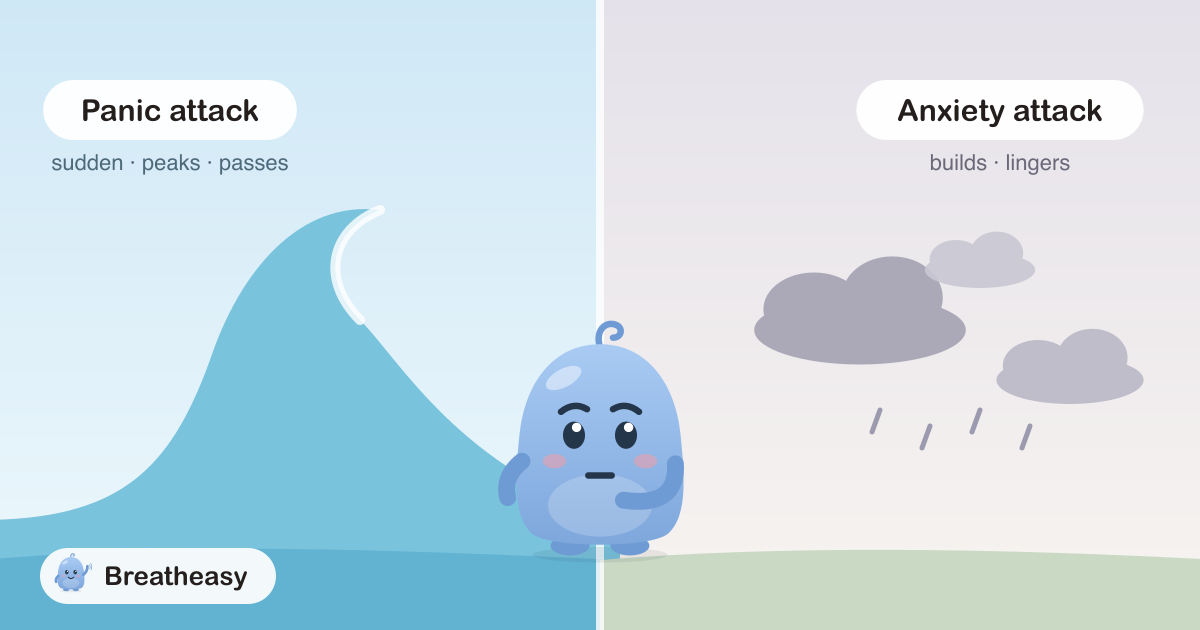
“I had an anxiety attack.” “I think it was a panic attack.” People use these phrases all the time, often to mean the same thing. But many people notice there are two quite different experiences: one that hits like a sudden wave, and one that builds slowly like a storm.
Knowing which one you’re having helps you understand it, and choose what will help.
The short answer
A panic attack is a sudden surge of intense fear that peaks within minutes, often for no obvious reason, with strong body symptoms like a pounding heart and shortness of breath. It passes, usually within 20 minutes.
An anxiety attack usually means a period of intense anxiety that builds gradually in response to a worry or stress. It can be milder than a panic attack, but it often lasts longer, sometimes hours.
“Panic attack” is a medical term, with a clear definition. “Anxiety attack” isn’t a diagnosis, so it means different things to different people. Some use it for a panic attack, and some for a long, intense build-up of worry. Both are real, and both are your body’s alarm system at work.
Side by side
| Panic attack | Anxiety attack | |
|---|---|---|
| How it starts | Suddenly, often out of the blue | Gradually, usually around a worry |
| Peak | Within minutes | Slowly builds and can plateau |
| How long | Usually 5 to 20 minutes | Can last hours, or come and go over days |
| Main feeling | Intense terror, sometimes fear of dying | Worry, dread, tension, restlessness |
| Body | Strong and sudden: racing heart, breathlessness, shaking, tingling | Usually milder: tension, a churning stomach, a fast heartbeat |
| Trigger | Can happen with no trigger, even in sleep | Usually linked to something stressful |
These are typical patterns, not rules. Panic attacks can be expected, for example before a flight, and anxiety can surge suddenly too.
What a panic attack feels like
A panic attack tends to come out of nowhere. In seconds, you might have a pounding heart, a feeling you can’t breathe, chest tightness, shaking, sweating, dizziness, tingling and a sense of unreality, along with a powerful fear that you’re dying or losing control.
Doctors describe a panic attack as having at least four of 13 recognised symptoms. You can see them all in Panic attack symptoms: the full list, and read how it feels from start to finish in What does a panic attack feel like?
What an “anxiety attack” feels like
What people call an anxiety attack usually builds over minutes or hours, often around something specific: a deadline, a hard conversation, a health worry. You might feel:
- worry or dread that’s hard to switch off
- restless, on edge or irritable
- tense muscles, especially in your shoulders, neck or jaw
- a churning or knotted stomach
- a fast heartbeat or shallow breathing
- trouble concentrating or sleeping
Instead of peaking and passing, it can rumble on, rising and falling with your thoughts.
Can you have both?
Yes. A long build of anxiety can tip over into a full panic attack, especially when you’re tired or stressed. And after a panic attack, many people feel anxious for hours, or worry about the next one. That worry can then make another attack more likely.
What helps a panic attack
Panic needs calming in the moment:
- Name it: “This is a panic attack. It will peak and pass.”
- Slow your out-breath: in for 4, out for 6.
- Ground yourself: 5 things you can see, 4 you can touch, 3 you can hear, 2 you can smell, 1 you can taste.
- Let it come and go, instead of fighting it or escaping.
Our guide to anxiety and panic attacks goes through each step.
What helps a build-up of anxiety
Gradual anxiety responds well to things that bring your stress level down over time:
- Breathe slowly for a few minutes, even before it peaks. See our post on calm, box and 4-7-8 breathing.
- Move your body. A brisk walk uses up some of the adrenaline.
- Write the worry down, then ask yourself what, if anything, you can do about it today.
- Set a “worry time”: 15 minutes later in the day when you let yourself worry, so you can put it aside until then.
- Ease up on caffeine and alcohol, which both make anxiety worse.
How Breatheasy can help
Breatheasy helps with both. For a sudden panic attack, tap “I’m feeling anxious” and Luma walks you through slow breathing and grounding. For a slow build of anxiety, a few minutes of guided breathing, with your phone pulsing as you breathe in, can bring it down before it peaks. Breatheasy is coming soon to iPhone and Android.
When to get help
Talk to a doctor if panic attacks keep happening, if anxiety is with you most days, or if either one is stopping you doing things you want or need to do. Ongoing worry most days for six months or more may be generalised anxiety disorder. Repeated unexpected panic attacks, with fear of the next one, may be panic disorder. Both are common, and both are very treatable, especially with cognitive behavioural therapy (CBT).
If you have chest pain that spreads to your arm, jaw, neck or back, or you’re struggling to breathe, call 911 in case it’s something else.
Sources
- Panic disorder, NHS
- Generalised anxiety disorder (GAD), NHS
- Anxiety disorders, National Institute of Mental Health
- Panic attacks and panic disorder, Cleveland Clinic