Breatheasy
Anxiety and shallow breathing: why it happens and how to breathe deeper
Anxiety pulls your breath up into your chest, and shallow breathing can feed anxiety in return. How the loop works, and simple ways to breathe lower and slower.
 Breatheasy team27 October 2026 · 3 min read
When you’re anxious, your breathing changes. It gets faster and moves up into your chest and shoulders, so each breath is small and shallow. Many people do this so often that it becomes their normal way of breathing, without realising.
Shallow breathing and anxiety feed each other. Here’s how, and how to breathe in a calmer way.
What is shallow breathing?
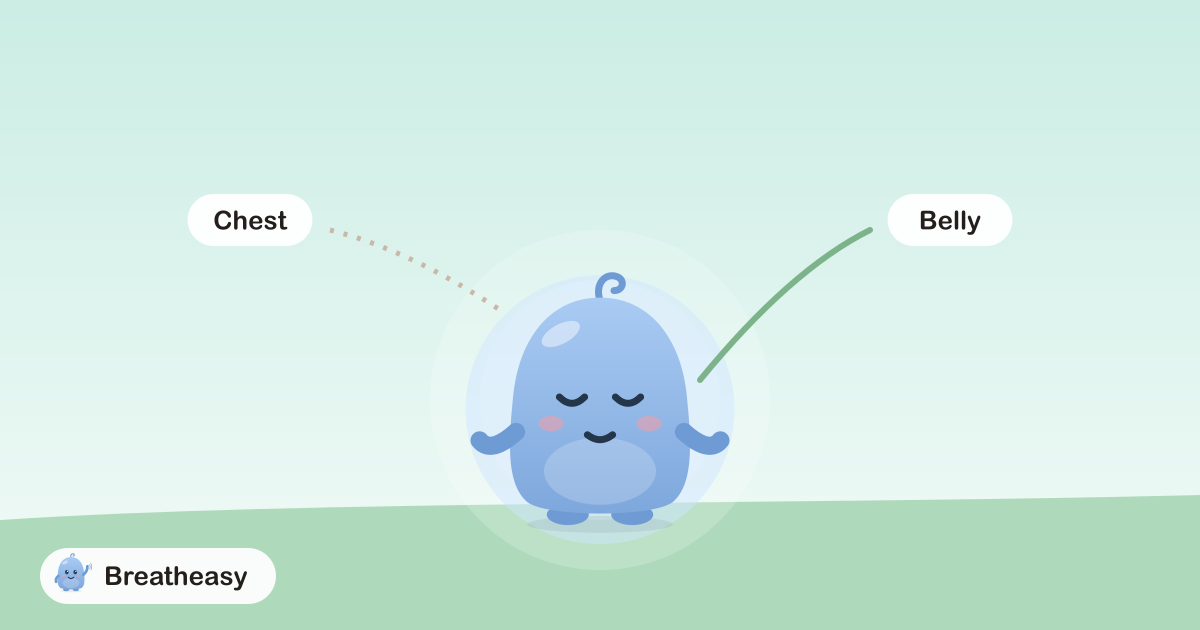
Shallow breathing, sometimes called chest breathing, is when you breathe mainly with your upper chest and shoulders, taking small, quick breaths. In calm breathing, most of the work is done by your diaphragm, the dome-shaped muscle under your lungs, so your belly gently rises as you breathe in.
Signs you might be breathing shallowly:
- your chest and shoulders rise more than your belly when you breathe in
- you sigh or yawn a lot
- you often feel you can’t get a satisfying breath
- your neck and shoulders feel tight
How anxiety causes shallow breathing
When your brain senses danger, the fight-or-flight response speeds up your breathing to bring in more oxygen for running or fighting. Your muscles tense, including around your chest and stomach, which pushes your breathing higher. Anxiety also makes you more likely to hold your breath, then catch up with quick, shallow breaths.
Can shallow breathing cause anxiety?
Yes, it works both ways. Breathing fast and shallow can mean you breathe out more carbon dioxide than usual. That small chemical change can cause:
- dizziness or light-headedness
- tingling in your fingers, feet or around your mouth
- a tight chest
- a racing heart
- feeling like you can’t get enough air
Those feelings are alarming, especially if you’re prone to panic, and the alarm makes you breathe even faster. That’s how shallow breathing can tip into a panic attack.
How to breathe deeper and slower
The aim isn’t to take huge, deep breaths, which can make overbreathing worse. It’s to breathe lower and slower.
- Sit or lie comfortably, with one hand on your chest and one on your belly.
- Breathe in gently through your nose for a count of 4, letting your belly rise under your hand. The hand on your chest should hardly move.
- Breathe out slowly through your mouth for a count of 6, feeling your belly fall.
- Repeat for 3 to 5 minutes.
If belly breathing feels strange at first, that’s normal. Try it lying down, where it often comes more easily.
Make calm breathing your default
- Practise daily, for a few minutes when you’re calm, so it becomes familiar.
- Check in a few times a day. Where is your breath right now? Chest or belly?
- Relax your shoulders and belly. Tight clothing and sucking your stomach in both push breathing higher.
- Move. Walking, swimming and yoga encourage fuller, steadier breathing.
Our breathing exercises for panic attacks and calm, box and 4-7-8 breathing posts have more techniques.
How Breatheasy can help
Breatheasy makes daily breathing practice easy. Its Calm, Box and 4-7-8 exercises run for 1, 3 or 5 minutes, and your phone pulses as you breathe in, so you can close your eyes and focus on breathing low and slow. If shallow breathing tips into panic, tap “I’m feeling anxious” and Luma walks you through it. The breathing exercises and panic button are always free. Breatheasy is coming soon to iPhone and Android.
When to get help
See a doctor if you often feel short of breath, if it’s new, or if it comes with other symptoms. How to tell if shortness of breath is from anxiety goes through the signs.
Call 911 if you’re struggling to breathe, have chest pain that spreads to your arm, jaw, neck or back, or your lips turn blue or grey.
Sources
- Breathing exercises for stress, NHS
- Russo, Santarelli and O’Rourke (2017). The physiological effects of slow breathing in the healthy human. Breathe.
- Shortness of breath, NHS